Buying a used engine feels like a gamble — and for many buyers, that uncertainty stalls the decision entirely. The worry is legitimate: one bad engine can cost more in labor and downtime than the savings ever justified. But the question "is it worth it?" is actually the wrong starting point, and asking it that way sets buyers up to make the wrong call.
Whether a used engine delivers value depends on three variables working together: the engine's verifiable condition, the supplier's actual inspection capability, and your specific use case. All three must align. A low-priced engine from an unverifiable source installed in a high-utilization truck is not a bargain — it's a liability. But a properly tested engine, sourced from a supplier with documented inspection processes, matched to a realistic workload, can deliver substantial savings with manageable risk.
That three-part framework sounds simple, but most buyer hesitations collapse because one of those variables is ignored — usually the middle one. The sections below break down each factor, and explain exactly what to look for before committing.
Is a used engine's condition actually verifiable?
Most buyers ask about price first and condition second. That order gets them into trouble. Condition is not a fixed fact — it's a range, and different suppliers measure it differently, or don't measure it at all.
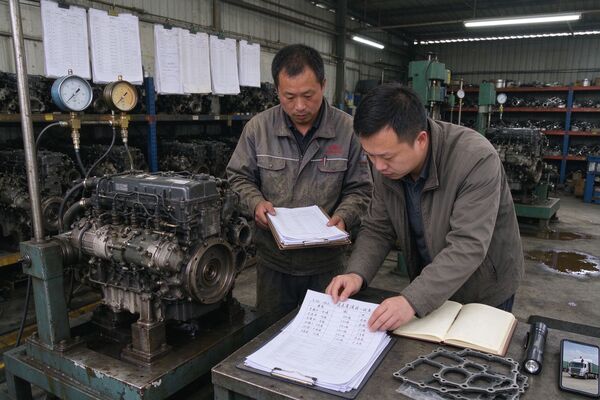
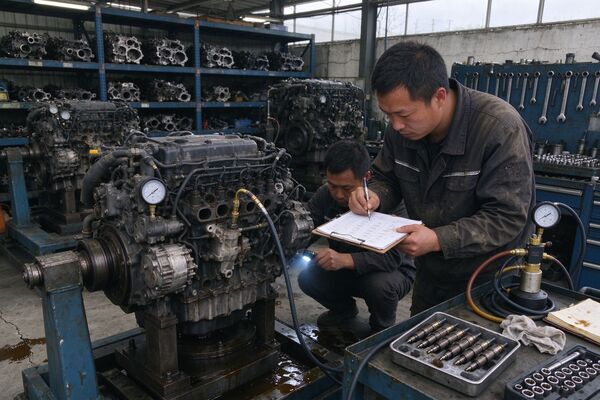
A used engine's condition is verifiable, but only if the supplier has run the right tests. Relevant checks include compression testing, oil pressure testing, leak detection, and ideally a dynamometer run under load[1]. Without documented test results, "good condition" is a sales claim, not a technical assessment. Buyers should request specific test records, not general assurances.
The word "used" describes a legal status, not a mechanical one. From what we've seen across hundreds of buyer consultations, the engines that cause the most post-sale problems are rarely the ones with the highest mileage — they're the ones no one actually tested before shipping.
What "condition" actually means for a used engine
Condition is a spectrum determined by at least four factors:
- Mileage and hours: High mileage isn't automatically disqualifying. A 400,000 km engine that was well-maintained and properly stored can outperform a 200,000 km unit that was run hard on poor-quality fuel and left sitting outdoors for two years[2].
- Maintenance history: Was oil changed on schedule? Were air and fuel filters maintained? This history is often undocumented, which is why physical inspection matters more than seller-provided records.
- Storage conditions: Engines stored outdoors in humid climates — something we see frequently with units sourced from equatorial markets — develop internal corrosion faster than buyers expect[3]. A visual check of the interior via borescope can catch this.
- Pre-sale testing: This is the variable that most directly separates reliable suppliers from unreliable ones. Has the engine actually been run? Was oil pressure stable? Did it hold compression across all cylinders?
What to request from any supplier
Before committing to a purchase, ask for:
- Compression test results — cylinder-by-cylinder readings, not just a pass/fail summary
- Oil pressure test data — measured at idle and under load
- Leak-down test results — especially relevant for older or high-mileage units
- Startup and run video — a short video of the engine running cold, warming up, and stabilizing is easy to produce and hard to fake
- Photos of internal components — valve covers removed, oil pan inspected
If a supplier cannot or will not provide these, treat that as a data point about their inspection capability, not just their communication style.
Common engines buyers ask us about
We regularly field inquiries on engines across several categories. For diesel-powered commercial trucks, some of the most requested units in our market include:
- Cummins 6BT — a 5.9L inline-six commonly found in medium-duty trucks and construction equipment; widely valued for its mechanical simplicity and parts availability in African and Southeast Asian markets
- Cummins 6LT — a 8.9L engine used in heavier applications; buyers typically ask about it for long-haul truck replacements
- Cummins 6CT — another 8.3L workhorse from the same family, common in dump trucks and mixers; buyers need to verify which emissions standard and injection configuration applies to their chassis
- Isuzu 4HK1 — a 5.2L four-cylinder found in medium trucks and buses; popular in Southeast Asia and East Africa for its fuel efficiency relative to its output class
For all of these, the testing requirements are the same. Brand reputation tells you about the design — it does not tell you about the condition of the specific unit in front of you.
Does your use case change the risk calculation?
This is the question most buyers skip. They evaluate a used engine as if it exists in a vacuum, without asking what happens if it fails in their specific context.
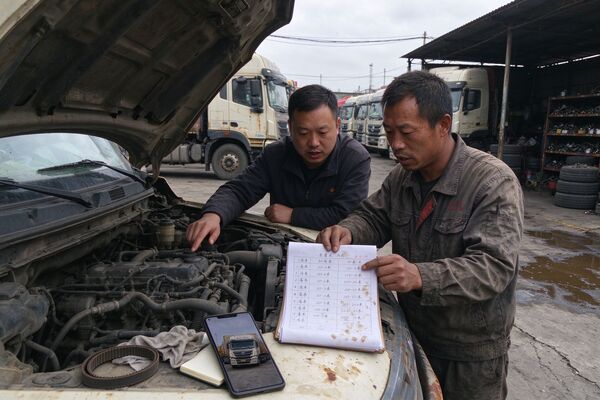
Your use case determines how much risk is acceptable. A used engine in a low-utilization backup vehicle carries fundamentally different stakes than the same engine in a truck running 400–500 km per day. The right question is not "is this engine good?" — it is "what does failure cost me if this engine fails in this job?"
This framing isn't pessimism. It's the same logic any logistics or fleet manager applies to insurance, maintenance reserves, or spare parts inventory. Risk tolerance is not a fixed personality trait — it's a function of stakes.
Matching engine condition to operational demand
Consider the following scenarios, which reflect buyer profiles we regularly work with:
| Buyer Type | Typical Use Case | Failure Cost | Recommended Condition Level |
|---|---|---|---|
| Spare parts distributor | Resale inventory | Moderate (reputation risk) | High — must pass full inspection for resale |
| Fleet owner (long-haul) | 400–500 km/day, revenue-critical | High — immediate downtime | Very high — dynamometer test recommended |
| Truck repair workshop | Customer repair job | Medium — relationship risk | High — full test records needed |
| Construction company | Backup or secondary unit | Low-to-medium | Moderate — inspection still required |
| Fleet owner (urban, short-haul) | 80–150 km/day, lower revenue per day | Lower | Moderate — compression and leak tests sufficient |
How downtime cost should shape your budget
One pattern that comes up repeatedly in our sales conversations: buyers who focus exclusively on unit price consistently underestimate the total cost of an engine replacement. The installed cost includes:
- Labor — engine swap in a heavy truck typically runs 8–20 hours of shop time, depending on model complexity[4]
- Associated parts — gaskets, belts, hoses, filters, and mounting hardware that should be replaced during installation
- Downtime — if the truck generates revenue, every day it's off the road has a measurable cost that belongs in the equation
- Re-installation risk — if the first engine fails quickly, you pay labor twice
When buyers run the full calculation, a used engine priced 40% below market that fails within 60 days often costs more total than a well-inspected unit priced 15% below new. This is not an argument against buying used — it's an argument for buying right.
How do you evaluate a supplier's inspection capability?
Price and brand are easy to compare. Inspection depth is invisible unless you know what questions to ask. This is where most procurement mistakes actually happen.
A supplier's inspection capability is the most important — and least visible — variable in a used engine purchase. Buyers should ask specifically what tests were performed, who performed them, and whether results are documented. Generic assurances like "fully inspected" or "good condition guaranteed" are not substitutes for test records and verification procedures.
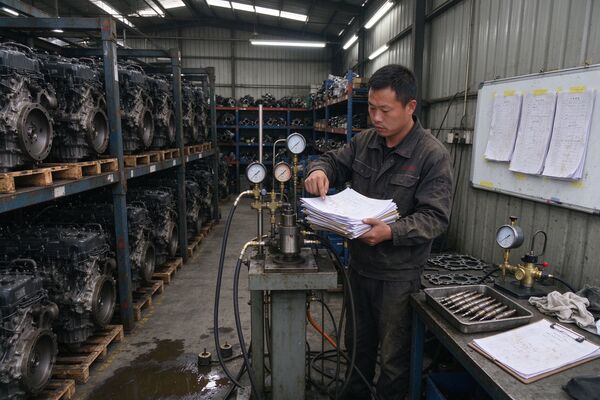
From our experience handling export inquiries from markets in Africa, Southeast Asia, the Middle East, and South America, buyers who ask specific questions about testing get better outcomes. Not because asking changes the engine — but because it quickly separates suppliers who actually run tests from those who don't.
Questions that reveal a supplier's actual inspection depth
Ask these before discussing price:
- "What tests do you run before listing an engine for sale?" — A serious supplier can answer immediately and specifically. Vague answers are informative.
- "Can you provide compression readings for this unit?" — Not "we test compression," but actual numbers.
- "Was this engine started and run before you listed it?" — If yes, ask for a video.
- "Do you have photos of the internal condition?" — Valve train, oil pan, and cylinder head surface.
- "What warranty or support do you offer if problems arise after delivery?" — This reveals how confident the supplier is in their own inspection.
What a responsible inspection process looks like
At Deli Auto, before any engine ships, the typical inspection sequence we carry out includes:
- Visual inspection — external condition, mounting points, oil leaks, physical damage
- Compression test — cylinder-by-cylinder; any cylinder reading significantly below the others flags an issue
- Oil pressure check — cold start and warm idle
- Leak test — coolant system and fuel system
- Run test — engine started and run to operating temperature, exhaust checked, idle quality assessed
- Documentation — photos and test records compiled for the buyer
We are not an engineering laboratory. We don't claim laboratory precision. But the engineers on our team have handled hundreds of engines across the models we stock, and pattern recognition from that volume of work is genuinely useful in pre-shipment evaluation. Buyers should always factor in their own qualified mechanic's review upon arrival.
Red flags in supplier communication
Watch for these signals:
- No test records available — "we inspect everything" without documentation
- Unwillingness to provide photos before payment — a legitimate supplier has nothing to hide
- Pressure to decide quickly — used inventory does move, but pressure tactics are a different thing
- Inability to answer model-specific questions — a supplier who can't tell you which injection configuration a specific unit carries probably hasn't looked at it carefully
Does the total cost equation actually favor buying used?
The headline saving on a used engine is real. But whether it survives contact with the full cost picture depends on decisions made before and after the purchase.
A used engine delivers genuine savings when the purchase price difference over new exceeds the realistic total of installation labor, associated replacement parts, and any downtime risk premium. For buyers with in-house mechanical capability and access to reliable sourcing, savings of 40–70% versus new are achievable. Without those conditions, the saving can disappear.
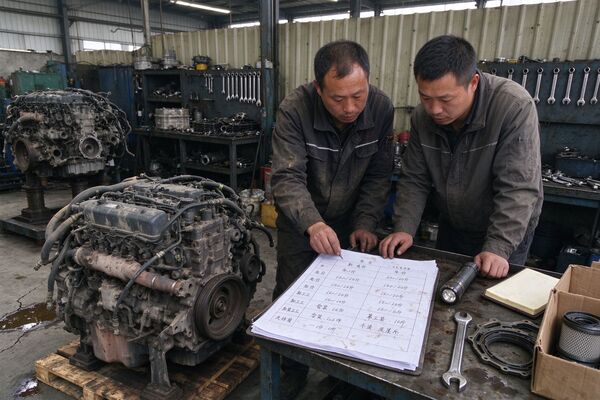
Breaking down the real cost comparison
Here is a framework for evaluating the actual equation:
New engine cost (baseline):
- Purchase price
- Shipping
- Import duties (market-dependent)
- Installation labor
- Consumables at installation
Used engine cost (realistic total):
- Purchase price
- Shipping (often comparable or lower due to sourcing flexibility)
- Import duties
- Installation labor (same as new)
- Consumables at installation (same)
- Risk premium — your estimate of the probability of early failure, multiplied by the cost of re-doing the job
The risk premium is where most buyers miscalculate. If there's a 20% chance of an engine failing within six months and a re-installation costs $1,500 in labor plus another $2,000 for a replacement unit, the expected risk cost is $700[5]. That needs to be subtracted from your apparent saving.
When the used engine equation clearly works
Based on the types of buyers we work with, the economics of used engines tend to work best when:
- The buyer has in-house mechanical capability — so labor costs are controlled and diagnosis is fast
- The application is medium-to-low daily utilization — lower daily revenue means lower downtime cost per day if something goes wrong
- The buyer is purchasing in volume — dealers and distributors who buy multiple units can absorb individual variance better than a single-unit buyer
- The supplier provides documented inspection and post-sale support — this shifts risk back toward the supplier and reduces the buyer's risk premium calculation
When new is the smarter call
There are use cases where we would tell a buyer directly that a used engine is probably not the right choice:
- Long-haul tractor trucks running revenue-critical routes with no spare chassis available
- Markets where spare parts for a specific engine are scarce — failure means extended downtime regardless of cost
- Buyers with no local mechanical support who cannot diagnose or address problems quickly
This is not a sales-avoidance position — it's the kind of guidance that builds long-term supplier relationships rather than short-term transactions.
Frequently Asked Questions
How do I know if a used engine has been properly tested before shipment?
Ask the supplier for specific test records: compression readings per cylinder, oil pressure data, and a startup video. If they can provide these with minimal hesitation, their inspection process is real. If they respond with general assurances but no documentation, that is a meaningful signal about how thoroughly the engine was actually evaluated.
What mileage range is acceptable for a used engine?
Mileage alone is not a reliable condition indicator. A well-maintained engine at 400,000 km can be a better purchase than a neglected one at 150,000 km. Compression test results, oil pressure readings, and internal inspection photos are more useful than odometer figures for assessing remaining service life.
Can I buy a used engine and still get after-sales support?
Yes, but support quality varies significantly by supplier. Ask specifically what post-sale support is offered before purchasing. At Deli Auto, we provide lifetime technical consultation on engines we supply, which gives buyers a resource for troubleshooting after installation — though this does not replace qualified local mechanical assessment.
Are used engines from China reliable for markets in Africa or Southeast Asia?
Reliability depends on the specific engine, its condition, and the supplier's inspection process — not the geography of the exporter. Chinese-sourced used engines that have been properly tested and documented ship successfully to Africa, Southeast Asia, and the Middle East regularly. The same engine sourced with no inspection creates the problems that give used parts a bad reputation.
What is the difference between a used engine and a remanufactured engine?
A used engine is removed from a vehicle, inspected, and sold in its current condition with minimal rework. A remanufactured engine is disassembled, worn components are replaced to factory tolerances, and it is rebuilt to a defined specification.[6] Remanufactured units cost more but carry tighter performance guarantees. For many buyers, a well-inspected used engine in good condition is the practical middle ground between new and remanufactured.
Conclusion
Buying a used engine is worth it — under the right conditions, with the right supplier, for the right application. That is the honest answer. Whether those conditions exist in your specific situation is a question no article can answer for you, but the framework is straightforward: verify the engine's condition through documented tests, evaluate the supplier's actual inspection capability rather than their marketing language, and run the total cost equation before comparing purchase prices.
The buyers who get consistent value from used engines are not the ones who found the cheapest supplier — they are the ones who asked the most specific questions and matched the engine's verified condition to their actual operational demands.
If your situation matches the use cases described here — fleet replacement, parts distribution, workshop sourcing, or multi-unit procurement — and you are evaluating Cummins or Isuzu engines for export, contact Deli Auto with your specific model requirements and application details. We will tell you what we have, what it tested at, and whether it's the right fit for your job — not just whether it's available.
[1] "Three steps on how to do an engine leakdown test", https://www.mobil.com/en/lubricants/for-personal-vehicles/auto-care/vehicle-maintenance/how-to-do-a-leakdown-test. Industry technical guidelines and engine rebuilders' associations identify compression testing, oil pressure measurement, and leak-down testing as foundational pre-sale diagnostic procedures for used internal combustion engines, with dynamometer load testing recommended for high-utilization applications. Evidence role: expert_consensus; source type: institution. Supports: That compression, oil pressure, leak-down, and load testing constitute the standard diagnostic battery for assessing internal combustion engine condition prior to sale or installation.. Scope note: Specific procedural standards vary by engine family and application class; a single universal protocol does not exist across all diesel engine types. ↩
[2] "Analytical approach to wear rate determination for internal ...", https://www.academia.edu/472219/Analytical_approach_to_wear_rate_determination_for_internal_combustion_engine_condition_monitoring_based_on_oil_analysis. Research in fleet reliability engineering indicates that engine wear rates are significantly influenced by lubrication interval adherence, fuel quality, and thermal cycling patterns, such that mileage is an incomplete proxy for mechanical condition without accompanying maintenance records. Evidence role: general_support; source type: research. Supports: That engine service life and residual condition are more strongly correlated with maintenance practices and operating conditions than with odometer mileage alone.. Scope note: Most published studies focus on new-engine wear curves rather than the resale condition of specific used units, so direct extrapolation requires caution. ↩
[3] ""The Effect of Temperature and Relative Humidity ... - MavMatrix", https://mavmatrix.uta.edu/mechaerospace_theses/822/. Corrosion engineering literature establishes that ferrous metal surfaces exposed to relative humidity above approximately 60% undergo accelerated oxidation, with tropical and equatorial storage environments presenting substantially higher corrosion risk to unprotected engine internals than temperate dry storage. Evidence role: mechanism; source type: research. Supports: That elevated ambient humidity during storage accelerates oxidative and electrochemical corrosion of ferrous internal engine components such as cylinder bores, camshafts, and crankshafts.. Scope note: Corrosion rates depend on additional variables including protective coatings, oil film retention, and temperature cycling; the cited mechanism is general and not specific to any engine model. ↩
[4] "Bus and Truck Mechanics and Diesel Engine Specialists", https://www.bls.gov/oes/2023/may/oes493031.htm. Commercial truck repair labor guides and fleet maintenance references indicate that engine R&R (remove and replace) operations on medium- and heavy-duty trucks generally fall within an 8–20 hour range, with variation attributable to cab-over versus conventional configurations, accessory complexity, and technician experience. Evidence role: general_support; source type: other. Supports: That heavy-duty commercial truck engine removal and replacement typically requires between 8 and 20 hours of skilled mechanic labor, varying by vehicle model and engine configuration.. Scope note: Published labor times are estimates based on standard conditions; actual shop time varies with vehicle age, corrosion, and regional labor practices. ↩
[5] "Methodology", https://en.wikipedia.org/wiki/Methodology. Fleet management and operations research literature applies expected value and risk-adjusted total cost of ownership frameworks to maintenance and parts procurement decisions, incorporating failure probability estimates and associated downtime costs to compare sourcing options on a risk-normalized basis. Evidence role: mechanism; source type: research. Supports: That expected value analysis — multiplying failure probability by failure cost — is a recognized method for incorporating risk into total cost of ownership calculations in fleet and equipment procurement decisions.. Scope note: The specific failure probability figure used in the article's example (20%) is illustrative rather than empirically derived; actual failure rates vary substantially by engine condition, supplier inspection quality, and application. ↩
[6] "Motor & Equipment Manufacturers Association", https://www.ftc.gov/sites/default/files/documents/public_comments/16-cfr-part-20-guides-rebuilt-reconditioned-and-other-used-automobile-parts-industry-project-no.p127702-560948-00012/560948-00012-83343.pdf. Industry bodies such as the Automotive Parts Remanufacturers Association (APRA) and standards frameworks including ISO 22628 define remanufacturing as a process returning a used product to at least OEM-equivalent performance specification through disassembly, cleaning, inspection, and replacement of worn parts, distinguishing it from resale of inspected-but-unrestored used units. Evidence role: definition; source type: institution. Supports: That 'remanufactured' engines are formally distinguished from 'used' engines by a process of disassembly, inspection, replacement of worn components to OEM tolerances, and reassembly to a defined performance specification.. Scope note: Regulatory definitions of 'remanufactured' vary by jurisdiction and trade context; the distinction described reflects common industry usage rather than a single universally binding standard. ↩