Choosing the wrong shipping method for used trucks can derail an entire procurement plan before the cargo even leaves port. Container vs RoRo shipping for used trucks is a question I get from buyers almost every week — and the answer is rarely what they expect. The stakes are real: wrong routing means missed port access, rejected cargo, or a cost blowout that wipes out your margin.
The short answer: RoRo shipping requires a functioning, self-driving vehicle and a destination port that actually accepts RoRo vessels — two conditions that eliminate it for most used truck buyers in Africa, Central Asia, and inland Southeast Asia. Container shipping is more universally available, supports multi-unit loads, and works for trucks in any mechanical condition.[1] For buyers ordering multiple used trucks, container shipping frequently wins on per-unit cost as well.[2]
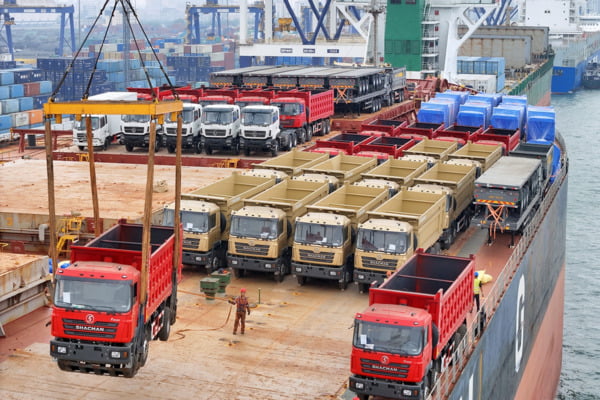
The difference between these two methods goes deeper than price. Before you compare freight rates, you need to answer two harder questions: Can your destination port even receive RoRo vessels? And is your truck in the right condition to board one? I'll walk through both — and then show you when the cost math actually favors containers.
Does Your Destination Port Support RoRo Shipping for Used Trucks?
Most buyers assume both options are available to them. That assumption causes more failed shipping plans than any other factor I see in my day-to-day work.
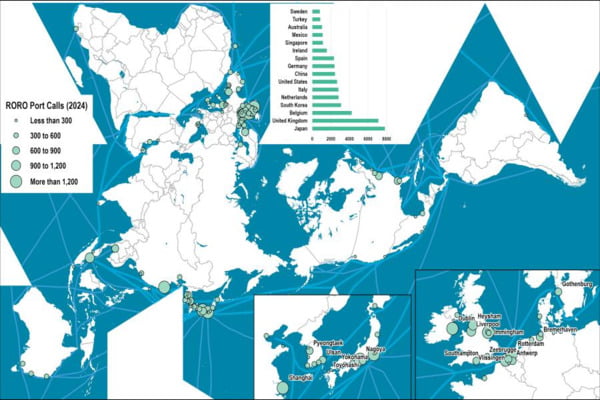
RoRo port coverage is not universal. Most ports in Sub-Saharan Africa, Central Asia, and inland Southeast Asia have limited or no direct RoRo vessel calls.[3] If your nearest port does not receive RoRo ships, the method is simply unavailable — no matter what the freight forwarder quoted you.
This is the hard gate in the decision. I treat it as the first question, not a secondary consideration.
Which Ports Actually Support RoRo?
RoRo services are concentrated around a relatively small number of high-volume ports globally.[4] In markets relevant to used truck buyers sourcing from China, the picture looks roughly like this:
| Region | Ports with Established RoRo Access | Typical Routing Reality |
|---|---|---|
| West Africa | Tema (Ghana), Apapa (Lagos), Abidjan | Limited direct China–West Africa RoRo; often requires transshipment via Europe or Middle East |
| East Africa | Mombasa, Dar es Salaam | Container dominant; limited RoRo calls |
| Middle East | Dubai (Jebel Ali), Oman | RoRo available but competitive with container; most buyers still use container |
| Southeast Asia | Jakarta, Manila, Bangkok | Container dominant; RoRo used mainly for new vehicle shipments |
| Central Asia | Landlocked (Kazakhstan, Uzbekistan, etc.) | No sea access; container via Bandar Abbas or Karachi is standard |
| South America | Santos (Brazil), Callao (Peru) | RoRo available but transhipment common from China |
Practical rule: If a buyer contacts me asking about RoRo shipping to Mombasa, Dar es Salaam, or any Central Asian destination, I redirect them to container immediately. There is no productive RoRo conversation for those ports.
The Transshipment Trap
Even for ports that technically accept RoRo cargo, direct China–origin RoRo services are sparse. Many RoRo routes from China require transshipment through a hub — often in the Middle East or Europe. That adds:
- Transit time: 2–6 additional weeks
- Handling risk: Vehicles are driven on and off vessels at each transshipment point
- Cost: Transshipment fees and potential waiting charges at the hub port
Once you factor in transshipment, the supposed simplicity of RoRo disappears. A direct container service from Guangzhou to Mombasa often arrives faster and with fewer handling touchpoints than a RoRo routing with a European transshipment.[5]
Is Your Used Truck Eligible for RoRo Shipping?
Even if your destination port accepts RoRo vessels, your specific truck may not qualify. This eliminates a large share of the used truck inventory that buyers in our markets are actually sourcing.
RoRo shipping requires vehicles to be driven on and off the vessel under their own power, or safely towed without damage.[6] Used trucks with engine faults, disassembled components, non-functional brakes, or oversized configurations are typically ineligible. Container loading is the correct default for any truck that is not road-operational.

What "Road-Operational" Really Means for RoRo
RoRo terminals are not repair yards. The terminal staff drive vehicles onto the ship and park them in the vessel's cargo deck. If a truck cannot:
- Start and idle reliably
- Steer and brake safely
- Meet the vessel's height and weight clearance specifications
...it will be refused at the ramp. I've spoken with buyers who planned RoRo shipments for trucks that had been partially disassembled for inspection or had known engine faults they intended to repair at destination. Both scenarios disqualify the vehicle.
Common Used Truck Conditions That Require Container Shipping
- Engine removed or non-functional — common in partial-refurbishment units
- Brake system incomplete or failed — a terminal safety issue
- Cab or chassis damage affecting driveability — structural concerns at the ramp
- Oversized configurations — certain tipper bodies, crane trucks, or extended trailers exceed RoRo deck clearances
- Partial disassembly for parts export — increasingly common for buyers sourcing both the truck and loose components together
At Deli Auto, a significant portion of our stock includes trucks that have undergone engine removal or mechanical work before export. For those units, container is the only viable shipping method — and we plan accordingly from the start.
For buyers sourcing used tractor trucks, dump trucks, or cargo trucks in working condition, you can browse our current used truck inventory to review available stock and mechanical status before deciding on your shipping method.
Is Container or RoRo Shipping Cheaper for Used Trucks?
This is where most online comparisons get it wrong. The "RoRo is always cheaper" assumption is outdated and often incorrect for used truck shipments from China.
Container shipping can achieve a significantly lower per-unit cost than RoRo when multiple trucks are consolidated into a single container load. A standard 40HQ container can carry 2–3 smaller trucks depending on configuration, distributing freight costs across units.[7] For bulk orders, this math frequently makes container the more cost-effective option.

Breaking Down the Real Cost Comparison
Rather than quoting specific rates (which shift constantly with market conditions and routes), I'll frame the cost factors that actually determine the outcome.
RoRo cost structure:
- Per-unit freight rate based on vehicle size (CBM or lane meters)
- Port surcharges at origin and destination
- Transshipment fees if no direct service
- Terminal handling charges
- No opportunity for consolidation
Container cost structure:
- Box rate for 20GP or 40HQ (fixed regardless of what's inside)
- Port handling at origin and destination
- Inland delivery to container yard
- Opportunity to consolidate multiple units or mixed cargo
When Container Wins on Cost
| Scenario | Container Cost Position |
|---|---|
| 2–3 small trucks (e.g., light cargo or crew-cab pickups) in one 40HQ | Per-unit cost split across the box — often lower than RoRo per unit |
| Mixed shipment of truck + spare parts + engines | Single container covers everything; RoRo cannot carry loose parts |
| Destination with RoRo transshipment | Container direct service may be cheaper and faster |
| Destination with high port theft or inspection risk | Container adds security value that RoRo cannot |
When RoRo Can Be Cost-Competitive
RoRo can genuinely make sense under specific conditions:
- Single large vehicle (e.g., a heavy haulage tractor with low-loader) that would need a dedicated container and special loading frame anyway
- Port with frequent direct RoRo calls from China, eliminating transshipment premium
- Vehicle is fully road-operational with no special loading requirements
- Buyer values speed and a direct RoRo service is faster than available container options
Even in these cases, I ask buyers to get a full landed-cost comparison — not just the ocean freight quote — before committing.
What About Cargo Security and Documentation?
This section matters more than most buyers realize, especially in markets with active port theft risks or strict customs inspection regimes.
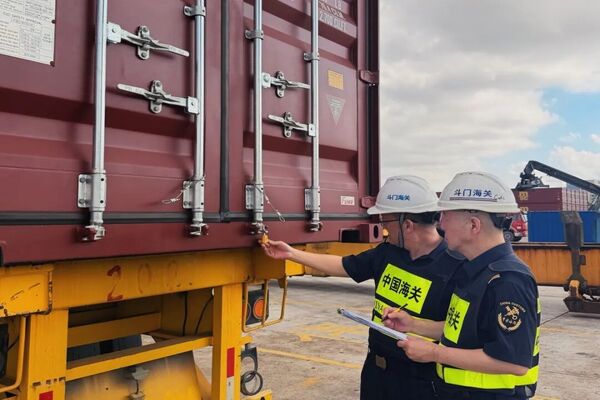
Container shipping provides enclosed, sealed transport with a unique container seal number traceable across the entire journey.[8] RoRo cargo is exposed on the vessel deck and handled by multiple terminal workers at each port.[9] For buyers with insurance requirements, strict customs inspection, or shipments to high-risk port environments, container shipping is the lower-risk default.
Documentation and Traceability Differences
| Factor | Container Shipping | RoRo Shipping |
|---|---|---|
| Cargo visibility during transit | Sealed; contents not accessible | Exposed on deck; accessible at each terminal |
| Seal/tracking reference | Unique container number + seal | VIN-based tracking only |
| Customs documentation | Bill of Lading per container | Bill of Lading per vehicle |
| Consolidation documentation | Multiple vehicles on one B/L possible | Individual B/L per unit standard |
| Insurance claim support | Easier to document condition at loading | Condition disputes at each handling point |
A Real Scenario That Shifted Our Recommendation
A buyer importing used trucks into a West African port with a known history of terminal theft asked me specifically about RoRo because he had heard it was cheaper. After we walked through the full cost comparison and I explained that his destination port had infrequent RoRo calls (meaning transshipment through a European hub), and that his trucks would sit exposed on an open deck through two terminal handlings, he chose container immediately. The price difference was marginal. The risk difference was not.
Frequently Asked Questions
Can I ship a non-running used truck by RoRo?
No. RoRo terminals require vehicles to board under their own power or be safely towed. A non-running truck will be refused at the terminal ramp. If your truck has engine problems, brake faults, or any condition that prevents safe driving, container shipping is the correct option.
How many used trucks fit in a 40HQ container?
It depends on the truck size and configuration. As a general guide, 2–3 light trucks or medium cargo trucks can fit in a single 40HQ, significantly reducing per-unit freight cost. Large tractor trucks or dump trucks typically require one container each. We assess fitment based on the specific vehicles before confirming container allocation.
Is RoRo faster than container for used trucks?
Not necessarily. For destinations where direct RoRo service from China is unavailable, RoRo requires transshipment through a hub port, which adds weeks to transit time. For many African and Asian destinations, a direct container service is actually faster than a RoRo routing with transshipment.
Does container or RoRo affect customs clearance at destination?
Both methods are accepted for customs purposes, but documentation differs. Container shipments use a single Bill of Lading that can cover multiple vehicles, which some customs authorities prefer for consolidated imports. Buyers should verify their destination country's import documentation requirements with a local clearing agent before booking.
Do I need to drain fuel and fluids before container or RoRo loading?
Fuel and fluid requirements vary by port, shipping line, and destination country. Most carriers require fuel tanks to be reduced to a minimal level (typically 1/4 tank or less) for both methods. We handle this as part of our pre-shipment preparation and confirm specific requirements per shipment.
Conclusion
Container vs RoRo shipping for used trucks is not a generic cost comparison — it is a decision that starts with port access, moves to vehicle condition, and only then reaches price. For most buyers in Africa, Central Asia, and Southeast Asia, RoRo is either unavailable at the destination port or incompatible with the mechanical condition of the trucks being sourced. Container shipping handles more routes, more vehicle conditions, and — for multi-unit orders — often delivers a better per-unit cost once consolidation is factored in.
At Deli Auto, we've handled container and RoRo logistics for buyers across more than 30 countries. We advise every buyer on the right method for their specific destination and order before any shipment is booked. If you're planning a used truck purchase and haven't confirmed your shipping method yet, contact us — we'll give you a direct answer based on your route, your vehicles, and your timeline.
[1] "List of busiest container ports", https://en.wikipedia.org/wiki/List_of_busiest_container_ports. UNCTAD's Review of Maritime Transport reports that containerization has expanded to thousands of ports worldwide, with container liner services providing connectivity to a far greater number of destinations than specialized RoRo networks, which remain concentrated at major vehicle trade hubs. Evidence role: statistic; source type: institution. Supports: That container shipping infrastructure reaches a substantially larger number of ports globally than RoRo services, making it more broadly accessible to importers across diverse destinations.. Scope note: Aggregate port count comparisons do not capture service frequency or capacity differences; a port may technically accept containers but have infrequent or indirect services. ↩
[2] "Study the Impacts of Freight Consolidation and Truck Sharing ...", https://rosap.ntl.bts.gov/view/dot/42413. UNCTAD's Review of Maritime Transport discusses the economics of containerization, including the cost advantages of load consolidation that allow shippers to distribute fixed box rates across multiple cargo units. Evidence role: general_support; source type: institution. Supports: That container freight economics allow per-unit cost reduction through cargo consolidation, which can make container shipping competitive with or cheaper than per-unit RoRo pricing.. Scope note: UNCTAD data covers general containerization economics rather than direct container-versus-RoRo cost comparisons for used vehicles specifically. ↩
[3] "Why Does Cargo Spend Weeks in Sub-Saharan African ...", https://documents1.worldbank.org/curated/en/335441468000911485/pdf/680140PUB0EPI0067902B09780821394991.pdf. UNCTAD's Review of Maritime Transport documents the geographic concentration of specialized vessel services, including RoRo, in high-volume trade corridors, with more limited coverage in lower-volume developing-country ports. Evidence role: general_support; source type: institution. Supports: That RoRo shipping infrastructure is concentrated in a limited number of high-volume ports and is less prevalent in Sub-Saharan Africa, Central Asia, and parts of Southeast Asia.. Scope note: UNCTAD data covers aggregate shipping trends and may not provide port-by-port RoRo call frequency for all regions mentioned. ↩
[4] "1 Introduction", https://arxiv.org/html/2604.18767v1. UNCTAD's Liner Shipping Connectivity Index and associated maritime transport data indicate that specialized vessel services, including RoRo, are concentrated at high-throughput ports, with many smaller or regional ports lacking regular RoRo calls. Evidence role: statistic; source type: institution. Supports: That RoRo shipping services are geographically concentrated at a limited number of major ports rather than distributed broadly across global port infrastructure.. Scope note: UNCTAD connectivity indices primarily measure container liner services; RoRo-specific port call frequency data requires supplementary sources such as vessel tracking databases. ↩
[5] "Shipping freight from China to Mombasa Kenya", https://sz-junqing.com/news/shipping-price-and-time-from-china-to.html. Port authority and shipping line schedule data for the China–East Africa trade lane document direct container services with transit times typically ranging from 20 to 30 days, providing a benchmark against which transshipment-dependent RoRo routings can be compared. Evidence role: general_support; source type: institution. Supports: That direct container liner services between Chinese ports and East African ports such as Mombasa operate with transit times that can be competitive with or shorter than indirect RoRo routings requiring hub transshipment.. Scope note: Transit times vary by carrier, season, and port congestion; a direct empirical comparison of container versus RoRo transit times on this specific route is not available from a single authoritative published source. ↩
[6] "Roll-on/roll-off", https://en.wikipedia.org/wiki/Roll-on/roll-off. The International Maritime Organization defines RoRo cargo as wheeled cargo driven or rolled on and off a vessel via ramps, a definition that inherently requires vehicles to be mobile or towable at terminal handling points. Evidence role: definition; source type: institution. Supports: That RoRo shipping is defined by vehicles being driven or rolled onto and off vessels, requiring a degree of vehicle operability.. Scope note: Specific terminal acceptance criteria for non-running vehicles vary by carrier and port operator and are not uniformly codified in a single international standard. ↩
[7] "40' Standard High Cube", https://www.hapag-lloyd.com/en/services-information/cargo-fleet/container/40-standard-high-cube.html. ISO standard 668 specifies the external and internal dimensions of series 1 freight containers, including the 40-foot high-cube variant, providing the dimensional basis for vehicle fitment calculations. Evidence role: general_support; source type: institution. Supports: The internal dimensions of a 40-foot high-cube container, which determine how many vehicles of a given size can be loaded.. Scope note: Container dimensions establish the physical envelope; actual vehicle fitment depends on individual truck dimensions and loading configuration, which vary by model. ↩
[8] "Bulletin - April 2014 - ISO 17712 High Security Seals", https://www.cbp.gov/sites/default/files/documents/Bulletin%20-%20April%202014%20-%20ISO%2017712%20High%20Security%20Seals.pdf. ISO 17712 establishes requirements for mechanical seals used on freight containers, specifying tamper-evidence and classification criteria that underpin the traceability claims associated with sealed container shipments. Evidence role: mechanism; source type: institution. Supports: That international standards govern the use of tamper-evident seals on freight containers, providing a traceable security reference across the shipping journey.. Scope note: ISO 17712 governs seal specifications but does not itself guarantee end-to-end tracking; actual traceability depends on carrier and customs systems at each handling point. ↩
[9] "Roll-on/roll-off", https://en.wikipedia.org/wiki/Roll-on/roll-off. Encyclopedia Britannica and maritime reference sources describe RoRo vessels as ships with internal vehicle decks accessed via stern or side ramps, where vehicles are parked by terminal drivers and remain accessible throughout the voyage. Evidence role: definition; source type: encyclopedia. Supports: That RoRo vessels store vehicles on internal or external decks accessible to terminal personnel at each port call, distinguishing them from sealed container stowage.. Scope note: Modern pure car and truck carriers (PCTCs) use enclosed decks, so the degree of exposure varies by vessel type; the claim is more applicable to open-deck or multi-purpose RoRo vessels. ↩