Sourcing a used Cummins engine model without proper verification is one of the most common procurement mistakes we see in the used truck and spare parts export business. Buyers specify a model name, receive what looks correct on paper, and only discover the mismatch months later — when parts don't fit, emissions compliance fails, or the engine underperforms under load.
Verifying a used Cummins engine model means confirming the CPL (Configuration Parts List) number and ESN (Engine Serial Number) against the actual build specification — not just reading a badge or nameplate. These two identifiers tell you the emission standard, power rating, fuel system configuration, and production market. Without them, you cannot reliably source matching parts or confirm what you are actually buying.

The nameplate is a starting point, not a verification. What comes after that first read is where real procurement risk either gets managed or ignored. The sections below walk through exactly how we approach this at Deli Auto — and what B2B buyers should demand from any used Cummins supplier.
Why Is the Nameplate Not Enough to Identify a Used Cummins Engine Model?
Many buyers trust the engine badge. It says "ISM" or "6BT" and they move forward. But nameplates can be worn, replaced, or simply misrepresent the actual configuration — and the commercial consequences arrive later.
The model name on a Cummins badge identifies the engine family and displacement platform. It does not tell you the emission tier, the power rating variant, the fuel injection system type, or the original equipment application. Two engines with identical nameplates can be fundamentally different products.[1]
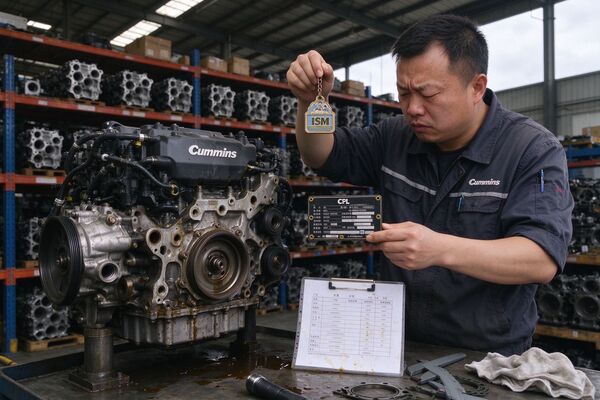
What the Nameplate Actually Tells You
A Cummins engine nameplate typically carries:
- Engine family and series name (e.g., ISB, ISM, QSB, 6BT)
- Displacement (approximate, encoded in the name)
- Country of manufacture (sometimes)
- Basic rated power (sometimes — and this can vary within the same series)
That is a short list. It tells you the platform. It does not tell you the configuration.
What the Nameplate Cannot Tell You
Here is what the nameplate leaves out — and what actually determines parts compatibility and compliance:
- Emission standard (Euro II, Euro III, Tier 3, or non-emissions-rated?)
- Fuel system type (mechanical injection vs. electronic common rail vs. CAPS system)
- Power rating variant (a 6BT, for example, has been produced in variants from roughly 105 hp to 175 hp depending on CPL[2])
- Original equipment application (on-highway truck, off-highway construction, marine, generator set — these carry different build specs even on the same platform)
- Market specification (North American spec, Chinese domestic spec, European spec, and export spec engines can all carry the same model name[3])
We see this pattern regularly with popular platforms like the Cummins 6BT and Cummins 6CT. Both are widely used, widely available used, and widely misrepresented — precisely because buyers and some sellers rely on the name rather than the configuration data.
Procurement rule of thumb: If a seller's entire engine description is a model name and a photo, treat that as an unverified engine, not a confirmed one.
What Is a CPL Number and Why Does It Matter for Verification?
Buyers who have never sourced used Cummins engines may not know the CPL number. That gap is one of the most exploitable information asymmetries in this market — and closing it is the single most practical thing a buyer can do before committing to a purchase.
The CPL (Configuration Parts List) number is a Cummins-specific code that identifies the exact build specification of an individual engine. It is not a model name. It is not a serial number. It is a configuration fingerprint.
What the CPL Number Encodes
Each CPL number maps to a specific combination of:
- Power rating (exact hp/kW output at rated RPM)
- Emission certification level (this determines regulatory compliance in import markets)
- Fuel system specification (injection pump type, electronic control module version)
- Governed speed and torque curve
- Original equipment application category
- Parts list — meaning which components are factory-spec for that exact configuration
This last point is commercially critical. When you order a fuel injection pump, a turbocharger, or an injector set for a Cummins engine, the correct part is determined by CPL — not by model name alone. Ordering by model name without the CPL is how workshops end up with parts that physically fit but run incorrectly.
Where to Find the CPL Plate
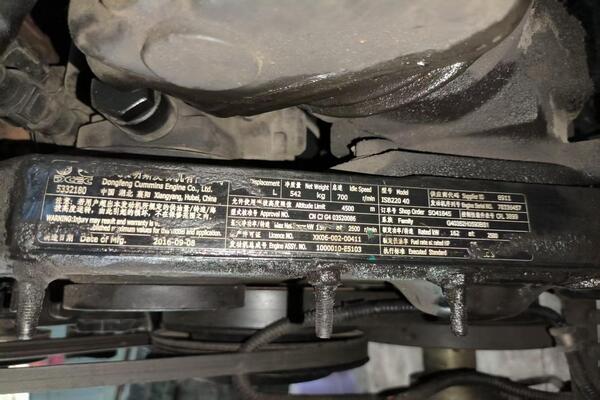
On most Cummins engines, the CPL plate is a small metal tag riveted to the engine block — often near the ESN dataplate, sometimes on the rocker cover or gear housing depending on the engine family. It is separate from the main nameplate.
When we inspect used Cummins engines at our facility, we physically locate and photograph this plate as a standard step. If the CPL plate is missing, that is a flag — not a disqualifier by itself, but it means the configuration requires cross-referencing against the ESN through a dealer system, which adds a verification step.
CPL Lookup: What Buyers Can Do Remotely
Cummins publishes a Quickserve Online portal where CPL numbers can be cross-referenced to configuration data. Buyers can use this to:
- Confirm the power rating matches what was quoted
- Check the emission tier associated with that CPL
- Identify the correct parts list for the configuration
This is a publicly accessible tool, and we recommend that buyers use it as part of their pre-purchase checklist — especially when sourcing remotely. Ask the seller for the CPL number. Then look it up yourself.
CPL Comparison: Same Model, Different Configurations
The table below illustrates how significantly two engines sharing a model name can differ based on CPL:
| Model | CPL Example | Power Output | Fuel System | Emission Tier | Typical Application |
|---|---|---|---|---|---|
| 6BT 5.9 | 0185 | 105 hp | Mechanical | Pre-emission | Agricultural / Off-highway |
| 6BT 5.9 | 8021 | 160 hp | Mechanical | Pre-emission | On-highway truck |
| 6CT 8.3 | 0841 | 210 hp | Mechanical | Pre-emission | Construction truck |
| 6LT 8.9 | 4965 | 285 hp | Electronic | Euro III | On-highway truck |
Note: CPL numbers and specs above are illustrative examples only. Always verify against Cummins Quickserve data for any specific engine.
These are not interchangeable engines. They share platform names. They do not share parts lists, compliance documentation, or performance specifications.
How Do You Use the ESN to Verify a Used Cummins Engine?
The Engine Serial Number (ESN) is the second mandatory verification step. The CPL tells you what configuration the engine was built to. The ESN tells you which specific engine you are looking at — its production date, manufacturing location, and original application record.
Used together, the CPL and ESN give a buyer a complete picture of what the engine is and where it has been. Used separately, each one leaves gaps.
Where Is the ESN Located?
The ESN location varies by engine family. For the most common platforms we handle:
- Cummins 6BT / 6CT / 4BT: Stamped on the engine block near the front gear housing, and on a dataplate attached to the block
- ISB / QSB family: Typically on a dataplate on the rocker housing or gear housing
- ISM / ISX / ISL family: Dataplate on the front gear cover or intake side of the block
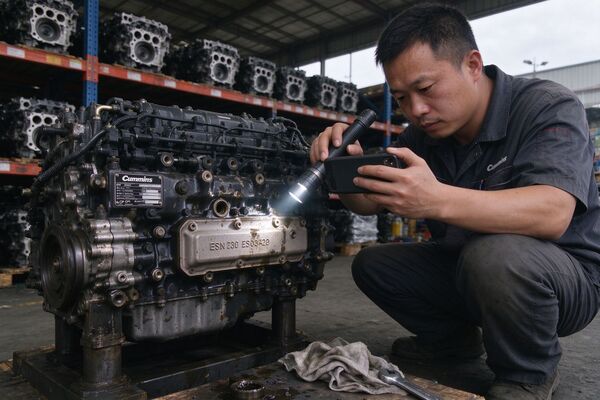
On engines with heavy wear, the stamped ESN can be difficult to read. We clean the area and photograph it under good lighting. If the ESN is illegible or appears tampered with, that is a serious procurement flag — not a cosmetic issue.
What the ESN Can Confirm Without Dealer Access
Even without logging into Cummins' internal systems, the ESN structure carries readable information:
- Manufacturing plant code (encoded in the prefix characters)
- Production sequence (approximate production date can be estimated from the serial range)
- Engine family (the ESN format differs between engine families, which serves as a cross-check)
Buyers can use the ESN on Cummins Quickserve Online for basic engine identification. This returns the engine's factory-recorded model, displacement, and in many cases the CPL — serving as an independent cross-check against what the seller has told you.
What the ESN Cannot Confirm Without Dealer Access
Be clear about the limits here:
- Service history is not accessible through public tools — only authorized Cummins dealers with dealer-level system access can pull warranty and service records
- Ownership history is not publicly accessible
- Rebuild or remanufacture status is not confirmed by the ESN alone — a rebuilt engine retains its original ESN but may carry non-factory components
When we export used Cummins engines to buyers in Africa, the Middle East, and Southeast Asia, we communicate these limits clearly. We can confirm configuration. We cannot provide a Cummins-certified service history for every engine — and any supplier claiming otherwise without documented proof deserves scrutiny.
ESN and CPL as a Cross-Check Pair
The practical verification workflow we use:
- Locate and photograph the ESN dataplate
- Locate and photograph the CPL plate (confirm they are on the same engine — mismatched plates are a red flag)
- Look up the ESN on Quickserve — confirm the engine family and CPL match
- Look up the CPL on Quickserve — confirm power rating and emission spec match what was quoted
- Document both numbers in writing in the sales contract or pro forma invoice
This five-step process takes less than 15 minutes per engine during our pre-shipment inspection. Any seller working with genuine inventory should be able to complete it without friction.
How Can Buyers Evaluate a Supplier Based on Their Verification Process?
A used Cummins engine supplier's ability — or unwillingness — to verify configuration data is itself a procurement signal. This matters more than any certificate or sales pitch.
Buyers sourcing remotely cannot perform hands-on verification themselves. That makes the supplier's inspection process the buyer's only quality control layer.[4] Understanding what questions to ask — and how to interpret the answers — is a core procurement skill.
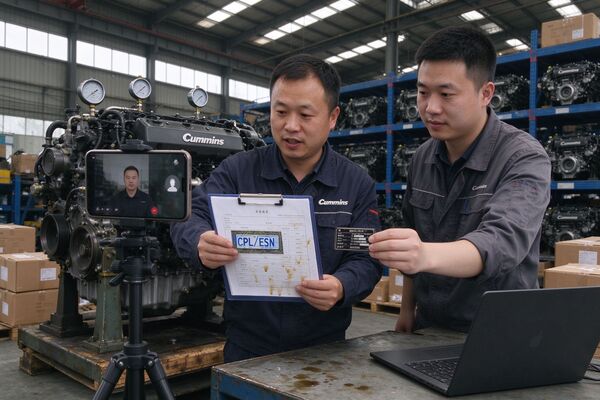
Questions to Ask Any Used Cummins Supplier
Before committing to a purchase, ask these specific questions:
- Can you provide the CPL number for this engine? A legitimate supplier with genuine inventory can answer immediately.
- Can you send a photo of the CPL plate and ESN dataplate together? This confirms both are present and readable on the same engine.
- What does the CPL show for emission tier and power rating? This tests whether the seller actually understands what they are selling.
- Has the engine been started and tested? Can you share a video? Running footage under load is more useful than static photos.
- What is the engine's application history — truck, generator, marine? Application history affects wear patterns significantly.[5]
What the Answers Tell You
| Supplier Response | What It Suggests |
|---|---|
| Immediately provides CPL number with Quickserve screenshot | Experienced, transparent, genuine inventory |
| Provides model name only, resists CPL request | Either doesn't know or doesn't want you to verify |
| Provides CPL but plates are missing in photos | Engine may have been disassembled or rebuilt — investigate further |
| Offers "certified" status without documentation | Marketing language — request the actual documents |
| Can explain configuration differences between CPL variants | Technically capable supplier — lower procurement risk |
How We Handle This at Deli Auto
When we process used Cummins engines for export, our inspection team documents:
- CPL plate photograph
- ESN dataplate photograph
- Quickserve lookup result
- Running test footage
- External condition photos (block, head, oil pan, exhaust manifold)
We provide this documentation package to buyers as part of the pre-shipment process — not as an optional add-on. Buyers purchasing engines for resale or fleet use need this documentation to support their own customers. A supplier who treats verification documentation as a burden is a supplier who has not built their process for serious B2B buyers.
Frequently Asked Questions
Can I identify a Cummins engine model from the serial number alone?
The ESN can confirm the engine family and often cross-reference to the CPL through Cummins Quickserve Online. However, the ESN alone cannot confirm every configuration detail without dealer-level system access. Always request both the ESN and the CPL number — they serve different verification functions and should cross-check each other.
What happens if the CPL plate is missing on a used engine?
A missing CPL plate is a flag, not an automatic disqualifier. The configuration may still be recoverable by looking up the ESN in Quickserve, which sometimes returns the original CPL. However, a missing plate limits verification confidence, and buyers should factor this risk into pricing negotiations or request additional documentation from the seller.
Are CPL numbers the same across all Cummins engine families?
CPL numbers are Cummins-specific and apply across their engine families, but the number format and plate location differ between families such as the B-series (4BT, 6BT), C-series (6CT), and ISX/ISM. Always verify the CPL against the correct engine family in Quickserve to avoid cross-family lookup errors.
How do I know if a used Cummins engine meets import emission standards for my country?
The CPL number cross-referenced in Quickserve will show the emission certification level the engine was built to. However, whether that certification satisfies your country's import regulations is a separate question — one that requires checking your national import authority's current requirements[6]. We recommend verifying this with your customs broker before purchase.
Is a Cummins engine marked "remanufactured" or "rebuilt" verified the same way?
The ESN and CPL process applies to remanufactured and rebuilt engines, but buyers should note that rebuilt engines may carry non-factory components that are not reflected in the original CPL parts list. A reputable seller should disclose what was replaced during rebuild. Request a rebuild record alongside the standard verification documentation.
Conclusion
Verifying a used Cummins engine model is a procurement decision, not a technical formality. The nameplate gives you a starting point. The CPL number gives you the actual build specification. The ESN gives you engine identity and a cross-check. Together, they tell you what you are really buying — and whether the parts, compliance, and performance will match your application.
At Deli Auto, we carry over 1,000 used engines in stock and document CPL and ESN data as a standard part of our pre-shipment inspection process. If you are sourcing used Cummins engines - whether a 6BT, 4BT, 6CT, 6LT or another platform – and you want a supplier who can walk you through the verification rather than just quote a model name, contact our team for inventory details and inspection documentation.
[1] "Cummins B Series engine", https://en.wikipedia.org/wiki/Cummins_B_Series_engine. Cummins Inc. technical documentation distinguishes between engine series designations, which identify a displacement platform, and CPL-level specifications, which define the exact power rating, fuel system, and emissions configuration of a given build; the two are not interchangeable for parts sourcing or compliance purposes. Evidence role: mechanism; source type: institution. Supports: That Cummins engine model names denote a platform family rather than a unique build specification, and that configuration-level identifiers are required to distinguish individual variants.. Scope note: Direct public documentation from Cummins on this distinction is primarily accessible through service portals such as Quickserve rather than freely published white papers, so secondary technical sources may be required. ↩
[2] "Cummins B Series engine", https://en.wikipedia.org/wiki/Cummins_B_Series_engine. Technical specifications published for the Cummins B-series 5.9-litre engine document multiple rated power outputs across different CPL configurations, reflecting the engine's deployment across agricultural, construction, and on-highway applications with differing performance requirements. Evidence role: statistic; source type: institution. Supports: That the Cummins 6BT 5.9-litre engine was manufactured in multiple power rating variants, with outputs spanning a range consistent with the article's claim of approximately 105 hp to 175 hp.. Scope note: Comprehensive CPL-level power rating data is maintained in Cummins' proprietary Quickserve database; publicly available sources may document only a subset of the full CPL range. ↩
[3] "Diesel engine", https://en.wikipedia.org/wiki/Diesel_engine. Research on global diesel engine supply chains documents that manufacturers routinely produce regionally differentiated variants of common engine platforms to comply with local emission regulations and application requirements, with these variants sharing model designations despite meaningful differences in fuel systems, calibration, and certified emission tiers. Evidence role: general_support; source type: research. Supports: That heavy-duty diesel engine manufacturers, including Cummins, produce market-specific variants of the same engine platform to meet differing regional emission standards, fuel quality assumptions, and application requirements.. Scope note: General supply chain research may not address Cummins-specific market variant practices directly; Cummins' own technical documentation or joint venture disclosures would provide more precise support. ↩
[4] "Purchasing Used Equipment | Procurement Services", https://finance.uw.edu/ps/how-to-buy/responsible-procurement/used-equpment. Research on international used equipment and parts trade identifies information asymmetry as a structural risk factor in remote procurement, where geographic separation prevents buyer-side inspection and supplier-provided documentation becomes the primary — and often sole — basis for quality assessment prior to shipment. Evidence role: general_support; source type: research. Supports: That remote B2B procurement of used industrial components creates information asymmetry conditions in which buyers are dependent on supplier-provided inspection data as a substitute for direct verification.. Scope note: General supply chain research on information asymmetry may not address used diesel engine procurement specifically; the cited support is contextual rather than a direct study of this market segment. ↩
[5] "Effects of duty cycles on diesel engine component life estimation", https://researchrepository.wvu.edu/cgi/viewcontent.cgi?article=2736&context=etd. Engineering literature on diesel engine tribology and maintenance documents that duty cycle characteristics — including load factor, thermal cycling frequency, and idle time — produce distinct wear patterns in engine components such as cylinder liners, bearings, and injection systems; engines from stationary generator applications, for example, typically exhibit different wear profiles than those from variable-load on-highway service. Evidence role: mechanism; source type: research. Supports: That diesel engine wear rates and failure modes differ systematically based on the operational duty cycle and application type in which the engine was used.. Scope note: Specific comparative wear data for Cummins engines across application types is not widely published in open literature; general diesel engine maintenance research provides contextual rather than direct support. ↩
[6] "Importing Vehicles and Engines into the United States", https://www.epa.gov/importing-vehicles-and-engines. National vehicle and engine import regulations differ substantially across markets in Africa, the Middle East, and Southeast Asia; some jurisdictions have adopted Euro-equivalent emission standards as import conditions, while others apply age-based restrictions or no emission-tier requirements, meaning that an engine's certified emission level must be assessed against the specific destination country's current regulatory framework rather than any universal standard. Evidence role: historical_context; source type: government. Supports: That national import regulations for used diesel engines vary significantly across destination markets, with some countries enforcing minimum emission tier requirements and others applying different or no such restrictions.. Scope note: Import regulations change frequently and vary at the sub-national level in some jurisdictions; a customs broker or national trade authority should be consulted for current requirements in any specific destination market. ↩