Choosing between a 6×4 and 4×2 tractor truck is one of the most consequential decisions a fleet buyer or truck dealer can make — and it is also one of the most misunderstood. Get it wrong, and you are not just looking at a suboptimal spec sheet. You are looking at stranded assets, unbudgeted fuel bills, and vehicles that cannot legally or physically do the job you bought them for.
The short answer: neither configuration is universally better. A 6×4 tractor truck delivers proven advantages in heavy haul, off-road terrain, and underdeveloped road infrastructure. A 4×2 is the stronger choice for regulated highway logistics where fuel economy and drivetrain simplicity drive profitability. The right configuration is determined by your operating task, route conditions, load weight, local axle-weight regulations, and total cost of ownership — not by axle count alone.
The answer lives in the details of your specific operation. Understanding why requires looking at each configuration on its own terms — what it does well, where it fails, and which buyer types it actually suits. Let me walk through that clearly.
What Do 6×4 and 4×2 Actually Mean?
Most buyers know the terminology, but the underlying mechanics matter for this decision.
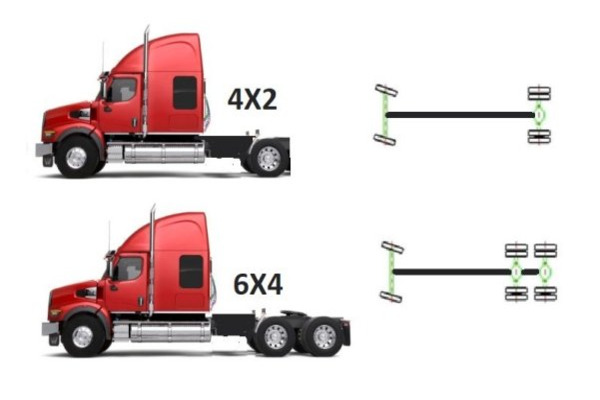
A 6×4 tractor truck has six wheels in total (three axles) with four driven wheels across two rear drive axles. A 4×2 has four wheels total (two axles) with two driven wheels on one rear axle.[1] The driven wheels are what deliver traction — and traction is the core variable this choice turns on.
The Drivetrain Difference in Plain Terms
The 6×4 configuration adds a second rear drive axle. This means:
- More driven contact points with the road surface
- Greater load-bearing capacity spread across more axles
- Higher traction in loose, wet, or unpaved terrain
- Greater gross vehicle weight (GVW) capability
The 4×2 removes that second drive axle. The result:
- Lighter overall vehicle weight, which directly benefits payload efficiency
- Simpler drivetrain with fewer components to maintain or replace
- Lower fuel consumption under highway conditions
- Lower purchase price, particularly in the used truck market
Neither of these is a value judgment. They are mechanical trade-offs. The question is which trade-off matches your operating environment.
Where Buyers Go Wrong: Axle Count Is Not a Quality Proxy
This is the first misconception I see in procurement inquiries we handle regularly. Buyers — particularly those purchasing for resale — sometimes assume a 6×4 is simply a "better" or "heavier-duty" truck and therefore a safer purchase. That framing is wrong.
A 6×4 Scania R500 deployed on long-haul tarmac highway routes in a fuel-cost-sensitive market is not a better truck. It is an over-specified truck, and it will cost the operator more to run without delivering a proportional operational return. Conversely, a 4×2 used in mining haulage on unsealed roads is not a cheaper option — it is a mis-specified truck, and it will underperform or fail prematurely.
The configuration must match the task. Full stop.
Where Does a 6×4 Tractor Truck Outperform?
The 6×4 faces a specific set of operating conditions where it has a clear, practical advantage.
For operations involving heavy loads, unpaved roads, steep gradients, or low-quality road infrastructure, the 6×4 is the appropriate — and often the only viable — choice. In markets like Sub-Saharan Africa and parts of Southeast Asia, these conditions are not exceptions. They are the daily operating environment.

Use Cases Where 6×4 Is the Right Call
Mining and construction haulage
In mining or construction contexts — quarries, dam projects, road-building sites — trucks operate on unpaved, graded, or muddy surfaces under heavy load. The dual rear drive axles of a 6×4 distribute traction across more contact points, reducing the risk of wheel spin, bogging, or drivetrain stress under load.[2] This is not a marginal advantage. It is the difference between a truck that completes the shift and one that does not.
Overloaded or high-GVW routes in markets with limited enforcement
In several African markets, actual payload carried on a given route regularly exceeds the nominal GVW.[3] The 6×4 platform — with its additional axle and broader load distribution — handles this operational reality more forgivingly than a 4×2. This does not mean overloading is advisable. It means that when buyers in these markets ask us what configuration holds up under real-world operating conditions, the 6×4 answer comes up consistently.
Low-quality road surfaces with gradients
A truck pulling a laden semi-trailer up a graded unpaved road needs driven traction — not just engine power. On sealed tarmac with good surface grip, a single rear drive axle is usually sufficient. On loose gravel, wet clay, or rutted tracks, a second drive axle is meaningful insurance.
Resale in markets where 6×4 is the dominant buyer preference
Dealers purchasing used trucks for resale need to understand what their end buyers will pay for. In many African and Southeast Asian markets, the 6×4 is simply what fleet operators and owner-drivers expect. Stocking 4×2 tractor units in a market with strong 6×4 buyer preference creates a slow-moving inventory problem. From the inquiries we handle at Deli Auto, this is a real issue for dealers who purchase on spec rather than on confirmed local demand.
6×4 Ownership Considerations
The additional driven axle comes with additional complexity:
| Component | 6×4 Implication |
|---|---|
| Rear differentials | Two instead of one — higher service interval cost |
| Drive shafts | Additional propeller shaft to the rear-rear axle |
| Tyres | More driven tyres to replace and align |
| Fuel consumption | Higher than equivalent 4×2 under highway conditions |
| Purchase price (used) | Generally higher than comparable 4×2 |
These are not reasons to avoid a 6×4. They are reasons to factor the full operating cost picture into the purchase decision before committing.
Where Does a 4×2 Tractor Truck Outperform?
The 4×2 is frequently underestimated by buyers who conflate simplicity with inadequacy. For the right operating profile, the 4×2 is not a compromise — it is the technically correct choice.
On sealed highway routes with regulated loads and predictable surfaces, the 4×2 delivers better fuel economy, simpler maintenance, and adequate traction. The question is whether your operation actually matches that profile.
Use Cases Where 4×2 Is the Right Call
Long-haul highway freight in markets with good road infrastructure
In South America, the Middle East, and parts of Southeast Asia where sealed highway networks are reliable and axle-weight regulations are enforced, long-haul operators running a 4×2 benefit from meaningfully better fuel economy over high annual mileage[4]. When multiplied across a multi-vehicle fleet, this difference compounds into a significant operating cost advantage. We recommend buyers in these markets request verified fuel consumption data for the specific models they are evaluating rather than relying on general claims.
Fleet operations focused on cost-per-kilometre
Fleet procurement managers running high-mileage operations on predictable routes typically evaluate trucks on cost-per-kilometre, not on raw capability. The 4×2 wins this calculation on most sealed-road profiles because:
- Lower unladen weight means better payload efficiency within axle-weight limits[5]
- Single rear drive axle means lower differential, driveshaft, and tyre replacement frequency
- Simpler drivetrain means faster and cheaper workshop servicing in markets where skilled mechanics may be scarce
Markets or corridors with strict axle-weight regulations
This is a decision variable many buyers overlook. Some road networks — particularly in Southern African countries and parts of Southeast Asia — have bridge weight limits or axle-load enforcement that effectively constrains which configurations can operate on certain routes.[6] A 6×4 configuration adds unladen vehicle weight, which reduces legal payload headroom under axle-weight limits. In these regulated contexts, a 4×2 may allow a higher legal payload per trip, which directly affects fleet economics.
Practical note: Before purchasing a batch of trucks for deployment in a specific country, verify the applicable axle-load regulations with a local logistics operator or transport authority contact. This is not a step to skip.
Dealers in markets with documented 4×2 buyer preference
Not every resale market is 6×4-dominant. Some urban freight and regional distribution markets — where routes are sealed and loads are regulated — have established buyer demand for 4×2 units. Dealers who understand their local buyer base rather than purchasing on assumption will stock accordingly.
4×2 Ownership Considerations
| Component | 4×2 Implication |
|---|---|
| Rear differential | Single unit — lower service cost |
| Tyres | Fewer driven tyres to manage |
| Fuel consumption | Lower under highway conditions vs. 6×4 |
| Purchase price (used) | Generally lower entry cost |
| Off-road capability | Limited — not suited for unsealed or soft surfaces |
| Resale value | Market-dependent — verify local buyer preference |
How Should Different Buyer Types Make This Decision?
Abstract comparison only goes so far. Let me map the decision to the three buyer types we most commonly work with.
Different buyer profiles have genuinely different correct answers. Treating this as a single universal recommendation serves none of them.
Used Truck Dealers Purchasing for Resale
Your primary variable is local market demand, not operational spec. The correct question is: what configuration do buyers in your target market actually purchase?
- Research whether your local fleet operators and owner-drivers predominantly run 6×4 or 4×2 units
- Understand whether local road infrastructure and load regulations favour one configuration
- Do not assume that what works in one country applies to a neighbouring market — road conditions and regulatory environments vary significantly even within the same region
- When purchasing from us or any used truck exporter, clarify the configuration before committing — a mixed stock order (some 6×4, some 4×2) may reduce your inventory risk if your market demand is unclear
Framework: If your buyers primarily operate on unpaved or mixed-surface routes under heavy load, stock 6×4. If your market is dominated by highway freight and regulated loads, 4×2 may move faster. Verify with your own buyer conversations before committing capital.
Mining and Construction Project Buyers
Your primary variable is terrain and load requirement. In most cases, the answer is 6×4, but the specification does not stop there.
- Confirm the engine torque and rated GVW match your actual payload and road gradient
- Verify the axle rating — not all 6×4 trucks are rated for the same maximum GVW
- Inspect the rear axle condition thoroughly on used units — the second drive axle accumulates wear faster on heavy-duty cycles
- Consider whether your site has workshop capacity to service a more complex drivetrain, or whether you need simpler vehicles that local mechanics can maintain
Framework: For off-road heavy haul, 6×4 is the correct configuration. Prioritise drivetrain condition in inspection, and verify the axle load rating against your actual payload before purchase.
Long-Haul Fleet Procurement Managers
Your primary variable is total cost of ownership over projected mileage and route type.
- Map your routes: what percentage of operating distance is sealed highway versus unsealed road?
- Understand your country's axle-weight enforcement — this may determine which configuration allows higher legal payload
- Evaluate fuel consumption data for specific models, not configuration generalisations
- Factor in local parts availability and workshop capability for the drivetrain you choose
Framework: For predominantly sealed highway operations with regulated loads, 4×2 typically delivers better cost-per-kilometre. For mixed or predominantly unsealed routes, 6×4 is the appropriate choice. A fleet running both route types may warrant both configurations in its order.
Frequently Asked Questions
Is a 6×4 tractor truck always better for heavy loads?
Not necessarily. A 6×4 handles heavy loads better on off-road or underdeveloped road surfaces. On sealed highways with axle-weight regulations, the additional unladen weight of a 6×4 can actually reduce your legal payload capacity per trip compared to a properly specified 4×2.
Can a 4×2 tractor truck handle rough roads at all?
A 4×2 can manage light unpaved surfaces at moderate load. It is not suited for sustained off-road use, steep loose-surface gradients, or heavy-haul on unsealed roads. Buyers deploying trucks in mixed environments — some highway, some site access — should assess the proportion of off-road exposure before deciding.
Which configuration is easier to maintain in markets with limited spare parts access?
The 4×2 is generally simpler to service due to its single rear drive axle. Fewer differentials, fewer driveshaft components, and fewer driven tyres reduce the range of parts a workshop needs to stock.[7] In markets where spare parts sourcing is challenging, drivetrain simplicity is a genuine operational advantage.
How does configuration affect resale value in African markets?
Resale value in African markets is heavily influenced by local buyer preference and prevailing route conditions. In many Sub-Saharan markets, 6×4 units are the dominant buyer expectation for heavy freight.[8] However, this varies by country and application sector. Dealers should verify local demand patterns before purchasing for resale rather than assuming one configuration is universally preferred.
What should I check during inspection of a used 6×4 tractor truck specifically?
Pay particular attention to both rear differentials, the inter-axle differential lock mechanism, all driven axle bearings, propeller shafts connecting both drive axles, and tyre wear patterns across all driven positions. Uneven wear on rear axle tyres can indicate alignment or differential issues that add up to significant repair costs.[9] We recommend a professional mechanical inspection by a qualified truck engineer before any multi-unit purchase.
Conclusion
The 6×4 versus 4×2 tractor truck decision does not have a universal winner. What it has is a correct answer for your specific operation — defined by your routes, your loads, your local regulations, and your total cost calculation over the vehicle's working life.
For heavy haul, off-road terrain, and markets where road infrastructure demands maximum traction, the 6×4 is the right tractor truck configuration. For sealed highway logistics, regulated-load environments, and cost-per-kilometre fleet operations, the 4×2 is the stronger choice. Dealers purchasing for resale must go one step further and verify what their local buyers actually demand before committing inventory.
At Deli Auto, we regularly help B2B buyers — from used truck dealers in West Africa to fleet procurement managers in Southeast Asia — work through exactly this decision before placing an order. We carry both configurations across multiple brands in ready stock, and our team can assist with pre-shipment inspection, configuration verification, and export logistics. If you are evaluating a purchase and want to discuss which configuration fits your specific operation, contact us directly.
[1] "AAR wheel arrangement", https://en.wikipedia.org/wiki/AAR_wheel_arrangement. The Society of Automotive Engineers (SAE) and commercial vehicle industry standards define truck configuration notation by total wheel count followed by driven wheel count, so a 6×4 denotes six total wheels with four driven across two rear axles. Evidence role: definition; source type: institution. Supports: The standard industry notation for truck wheel and drive axle configurations, where the first number denotes total wheels and the second denotes driven wheels. Scope note: Specific SAE standard documents may require subscription access; general encyclopedic or manufacturer technical documentation may serve as a more accessible proxy source. ↩
[2] "Truck Tire Pavement Contact Pressure Distribution ...", https://library.ctr.utexas.edu/digitized/texasarchive/phase2/1190-1.pdf. Vehicle dynamics and powertrain engineering literature describes torque distribution across multiple driven axles as a mechanism for reducing individual wheel slip angles and peak driveshaft stress, particularly under high-load, low-friction conditions characteristic of off-road heavy haulage. Evidence role: mechanism; source type: paper. Supports: That distributing drive torque across two rear axles reduces per-axle torque demand, lowering the likelihood of individual wheel spin and reducing peak drivetrain stress under heavy load on low-friction surfaces. Scope note: The practical magnitude of this effect depends on inter-axle differential configuration and whether a differential lock is engaged; open-differential 6×4 systems may not fully realise the theoretical traction advantage under all conditions. ↩
[3] "Publication: Guidelines on Vehicle Overload Control in ...", https://openknowledge.worldbank.org/entities/publication/c5eeabf0-ed8a-5a38-9cb2-1355c3b93aca. World Bank and African Development Bank transport sector studies have documented high rates of axle-load violations in Sub-Saharan African road freight, with surveys in multiple countries recording a substantial proportion of heavy vehicles operating above legal gross vehicle mass limits. Evidence role: statistic; source type: institution. Supports: That commercial vehicle overloading is a documented and widespread practice in African road freight markets, with actual payloads frequently exceeding legal GVW limits. Scope note: Overloading rates vary considerably by country, corridor, and enforcement regime; regional averages should not be applied uniformly to all African markets. ↩
[4] "and Heavy-Duty Truck Fuel Efficiency Technology Study – ...", https://www.nhtsa.gov/sites/nhtsa.gov/files/812194_commercialmdhdtruckfuelefficiency.pdf. Comparative fuel consumption studies of tractor truck configurations report that 4×2 units typically achieve 3–8% better fuel efficiency than equivalent 6×4 models under highway conditions, attributable to reduced drivetrain friction losses and lower rolling resistance from fewer driven tyres. Evidence role: statistic; source type: research. Supports: That 4×2 tractor trucks consume measurably less fuel than equivalent 6×4 configurations under highway long-haul conditions due to lower drivetrain friction and reduced unladen weight. Scope note: Fuel economy differences are sensitive to load, speed, terrain, and specific model; percentage ranges cited in literature may not transfer directly to all operating environments or truck generations. ↩
[5] "Compilation of Existing State Truck Size and Weight Limit Laws", https://ops.fhwa.dot.gov/freight/policy/rpt_congress/truck_sw_laws/app_a.htm. Engineering comparisons of equivalent tractor truck models in 6×4 and 4×2 configurations document unladen weight differences typically ranging from 300 to 600 kg, directly reducing legal payload headroom under gross vehicle mass regulations. Evidence role: mechanism; source type: research. Supports: That the additional drive axle and associated components in a 6×4 configuration add measurable unladen weight, reducing available legal payload under fixed gross vehicle mass limits. Scope note: Weight differences vary by manufacturer and model; figures cited in any single source may not be universally representative across all truck brands and markets. ↩
[6] "Compilation of Existing State Truck Size and Weight Limit Laws", https://ops.fhwa.dot.gov/freight/policy/rpt_congress/truck_sw_laws/app_a.htm. The Southern African Development Community (SADC) has established regional axle-load limits for heavy vehicles under its Protocol on Transport, Communications and Meteorology, with individual member states implementing national enforcement regimes that constrain vehicle configuration and payload on regulated corridors. Evidence role: general_support; source type: government. Supports: That Southern African Development Community member states and Southeast Asian countries maintain enforceable axle-load and bridge weight regulations that affect which truck configurations can legally operate on specific routes. Scope note: Enforcement consistency varies significantly between SADC member states and between Southeast Asian jurisdictions; the article's claim of active enforcement may not apply uniformly across all referenced regions. ↩
[7] "Spec'ing Trucks for Lower Total Cost of Ownership", https://fleetrabbit.com/article/spec-trucks-for-lower-tco. Fleet total cost of ownership analyses in commercial vehicle literature consistently identify drivetrain component count as a driver of maintenance expenditure, with 4×2 configurations showing lower differential and driveshaft service costs relative to tandem-drive 6×4 equivalents over comparable operating cycles. Evidence role: general_support; source type: research. Supports: That 4×2 tractor trucks incur lower drivetrain maintenance costs than 6×4 configurations due to having fewer differentials, driveshafts, and driven tyre positions requiring service. Scope note: Absolute maintenance cost differences depend heavily on operating intensity, road conditions, and parts pricing in specific markets; studies conducted in developed markets may not reflect cost structures in African or Southeast Asian operating environments. ↩
[8] "Forecasting vehicle fleets in Sub-Saharan african Countries", https://documents.worldbank.org/en/publication/documents-reports/documentdetail/113231468768020525. Industry analyses of Sub-Saharan African commercial vehicle markets, including reports from organisations such as the African Development Bank and regional automotive associations, document the prevalence of multi-axle drive configurations in heavy freight fleets operating on mixed and unpaved road networks. Evidence role: general_support; source type: institution. Supports: That 6×4 drive configurations represent the dominant share of heavy tractor truck demand in Sub-Saharan African markets due to road infrastructure and load conditions. Scope note: Aggregate regional data may obscure significant country-level variation; market composition in South Africa, for example, differs materially from West or Central African markets. ↩
[9] "Correcting uneven tire wear on rear axle?", https://www.facebook.com/groups/granddesignrvowners/posts/1891550118393803/. Commercial vehicle inspection standards and fleet maintenance engineering references identify asymmetric or accelerated tyre wear on driven axle positions as a diagnostic indicator of potential differential, bearing, or wheel alignment faults, with repair costs for differential replacement on heavy trucks commonly ranging into thousands of dollars. Evidence role: mechanism; source type: institution. Supports: That irregular tyre wear patterns on driven rear axles of heavy trucks are a recognised diagnostic indicator of misalignment, differential wear, or bearing failure requiring investigation before purchase. Scope note: Tyre wear patterns are one of several diagnostic indicators and should be interpreted alongside other inspection findings; wear alone is not conclusive evidence of a specific fault without further mechanical investigation. ↩