Loading multiple used trucks into one container is a question most buyers never think to ask — until a shipment arrives with cracked cabs, bent mirrors, or shifted chassis. The loading process is invisible during procurement, yet it determines whether your trucks arrive in the same condition they left our yard.
Loading multiple used trucks into a single container requires systematic disassembly, vehicle-specific stacking configurations, and mechanical securing — not simply driving trucks inside. The exact approach depends on truck type, chassis dimensions, and container floor capacity. For tractor heads, stacked cab-over-frame loading is common. For dump trucks and mixer trucks, side-by-side or offset positioning is more typical. Every configuration is planned before a single truck moves toward the container.
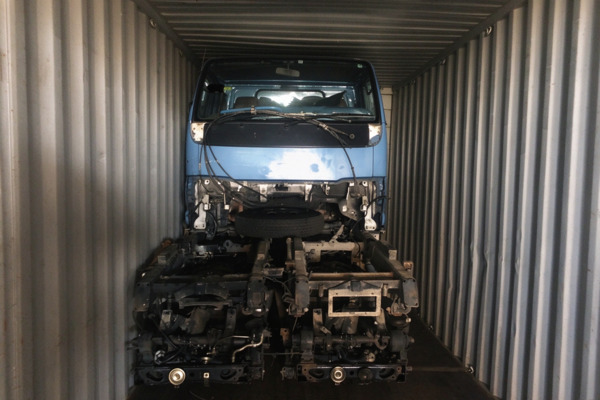
What follows is a breakdown of how our operations team actually executes this process at our 12,000㎡ facility in Guangzhou — drawn from over 20 years of loading commercial trucks for export to Africa, the Middle East, Southeast Asia, and beyond. If you are evaluating exporters on their loading capability, the details below will help you ask the right questions.
Why Does Loading Multiple Used Trucks into One Container Matter to Buyers?
Most buyers focus on price and inspection. Loading is an afterthought — until something goes wrong in transit.
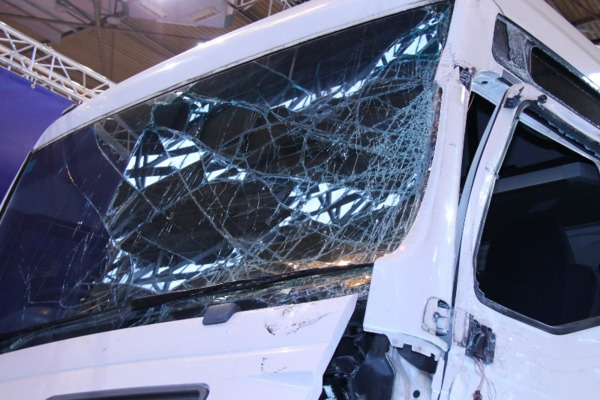
Improper container loading causes real, costly damage: cracked windshields from shifting during sea swells, torn cab panels from contact with container walls, and corroded chassis from moisture trapped under poorly positioned trucks[1]. These are not rare events. They are predictable consequences of inexperienced loading practice.
The way a supplier handles container loading is one of the clearest indicators of their export experience. Amateur loading often shares two visible traits: no disassembly of protruding components, and no documented securing plan. Either one raises the probability of cargo damage significantly.
Understanding the loading process also helps buyers interpret quotes. A supplier offering unusually low freight costs may be skipping disassembly labor, proper lashing materials, or corrosion treatment — costs that are real but invisible on an invoice. Knowing what professional loading involves helps you evaluate whether a price is competitive or simply cut.
What Disassembly Steps Are Required Before Loading?
Skipping disassembly is the most common mistake made by inexperienced exporters — and the most expensive one for buyers.
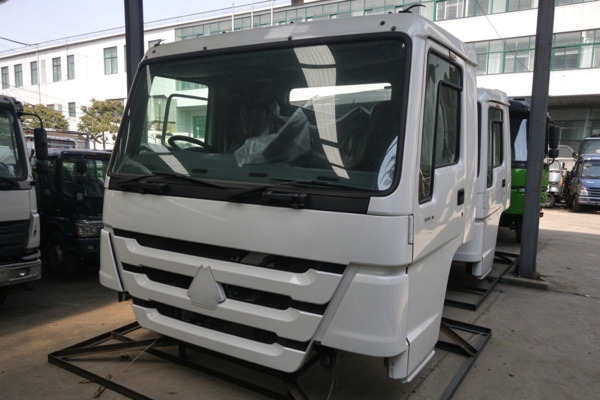
Before any used truck moves toward the container, our team removes all protruding components that would either exceed container clearance or make contact with adjacent vehicles or container walls during transit. These components are individually wrapped and shipped alongside the trucks.
Before loading, our team removes and separately packs: both door assemblies, exterior mirrors, exhaust pipe stacks, antenna mounts, and any accessory lighting bars. On tractor heads with sleeper cabs, we also remove the sun visor if it projects beyond the cab roofline. None of these items go back onto the truck until it reaches the buyer.
This step is non-negotiable. Here is why each item matters:
Why Each Component Must Come Off
- Doors: Even with careful loading, container walls flex during ocean transit. A door left on can make contact with the container wall and suffer panel damage or hinge stress. Removed doors are wrapped in foam blankets and secured flat.
- Exterior mirrors: The widest point on most commercial trucks is mirror-to-mirror. Removing mirrors reduces the effective width by 300–500mm on each side[2] — this is often the difference between fitting two trucks side by side or not.
- Exhaust stacks: Vertical exhaust pipes on tractor heads can reach heights of 4.0m or more. A 40HQ container has an internal height of approximately 2.7m[3]. The exhaust must come off before the truck can physically enter the container.
- Sun visors and roof bars: These affect whether stacking clearance is achievable on upper-tier trucks.
On a recent shipment of four Scania tractor heads in a single 40HQ container, disassembly of doors and exhausts alone took our team approximately six hours before loading even began. That labor is part of our standard process — it is not an optional add-on.
How Are Tractor Heads Loaded and Stacked in a Container?
Tractor heads — units like the Scania R-series or Volvo FH — are the most commonly stacked truck type in export container loading.
Stacking means placing one tractor head on top of another inside the container, with the upper unit's frame resting on the lower unit's chassis frame rails, not on the cab. Done correctly, this configuration allows two tractor heads to occupy roughly the same footprint as one. Done incorrectly, it destroys both units.
For tractor heads, we use a cab-over-frame stacking method: the lower unit sits wheels-down on the container floor, while the upper unit is inverted or positioned nose-to-tail and rested on the lower unit's chassis rails — never on its cab. This distributes load through the strongest structural members of the chassis. In a standard 40HQ container, we typically load four Scania or Volvo tractor heads using two stacked pairs.
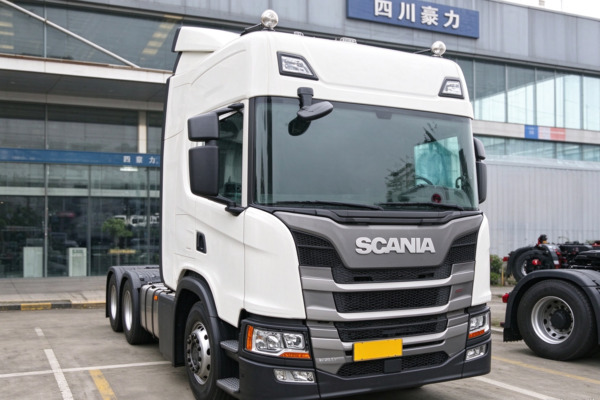
The Configuration Decision for Tractor Heads
The exact stacking arrangement depends on three variables our team assesses before loading begins:
- Chassis height of the lower unit — This determines how much vertical clearance remains inside the container for the upper unit. A taller chassis leaves less room; a lower fifth-wheel height gives more working space.
- Cab design — A flat-nose cab versus a long-nose cab affects how the upper unit can be oriented over the lower one without cab-on-cab contact.
- Weight distribution — We confirm that the stacked weight does not concentrate on the container floor's weakest points. Container floors have practical load limits per linear meter, and stacking doubles the point load in a small footprint[4].
For a recent shipment of four Scania R420 tractor heads:
| Position | Unit | Orientation | Resting Surface |
|---|---|---|---|
| Lower Left | Scania R420 #1 | Wheels down, nose forward | Container floor |
| Upper Left | Scania R420 #2 | Inverted, nose rearward | Chassis rails of #1 |
| Lower Right | Scania R420 #3 | Wheels down, nose forward | Container floor |
| Upper Right | Scania R420 #4 | Inverted, nose rearward | Chassis rails of #3 |
After all four units were positioned, our team applied wooden blocking under all contact points and ran cross-lashing straps to the container's anchor rings at a minimum of four securing points per truck. The doors, mirrors, and exhaust stacks were packed flat in the remaining floor space between and behind the stacked pairs.
Total loading time for this shipment was approximately one full working day with a crew of six.
How Are Dump Trucks and Other Large Trucks Loaded?
Dump trucks present a completely different loading challenge — and stacking is almost never an option.
A HOWO dump truck with a raised body, heavy rear axle configuration, and wide frame rails simply does not lend itself to the cab-over-frame stacking method used for tractor heads. The weight is too high, the geometry is too irregular, and the risk of cab crush or frame stress is unacceptable.
For HOWO dump trucks and similar heavy-body vehicles, we use a side-by-side or offset nose-to-tail configuration rather than stacking. In a 40HQ container, this typically allows two medium-wheelbase dump trucks when doors and mirrors are removed. Three units require careful wheelbase matching and are only feasible on shorter-wheelbase variants. Stacking is not used for dump trucks as standard practice.

Why Dump Trucks Cannot Simply Be Stacked
The reason comes down to three structural realities:
- Body overhang: Even with the dump body lowered, the rear of a dump truck is higher and heavier than the rear of a tractor head. There is no clean chassis rail to rest a second unit on.
- Axle weight: A fully equipped HOWO dump truck rear axle group can carry significant static load[5]. Placing a second unit's weight over that axle cluster through an improvised upper brace risks permanent chassis deformation.
- Cab vulnerability: Unlike a tractor head where the cab sits relatively low between the chassis rails, a dump truck cab is a more isolated structure. It cannot serve as a support point under any loading scenario.
Mixer Trucks: The Most Constrained Case
Concrete mixer trucks are in a category of their own. The rotating drum extends well beyond the cab and frame, occupies most of the available container height, and creates an irregular center of gravity. In our experience, mixer trucks are almost always shipped one per 40HQ container, or — in rare cases where dimensions align — two units with the drums partially overlapping in an offset configuration. This requires precise measurement of drum diameter and total transport height before any loading plan is committed to.
If a supplier tells you they can load three mixer trucks in a 40HQ without sharing specific measurements and a loading diagram, ask to see the plan in writing before confirming the shipment.
How Are Loaded Trucks Secured and Protected Inside the Container?
Positioning trucks correctly is only half the job. What keeps them in position across 20,000+ kilometers of ocean transit is the securing and corrosion protection work that follows.
Buyers rarely see this step — it happens after the trucks are in place, in a dark container, before the doors are sealed. Yet it directly determines the condition of the cargo on arrival.
Our securing process uses rated lashing straps anchored to the container's floor D-rings at a minimum of four points per vehicle, supplemented by hardwood blocking under wheels and chassis contact points. For stacked configurations, additional vertical lashing is applied between upper and lower units. We also apply anti-rust oil to exposed chassis members, brake drums, and axle flanges before sealing.
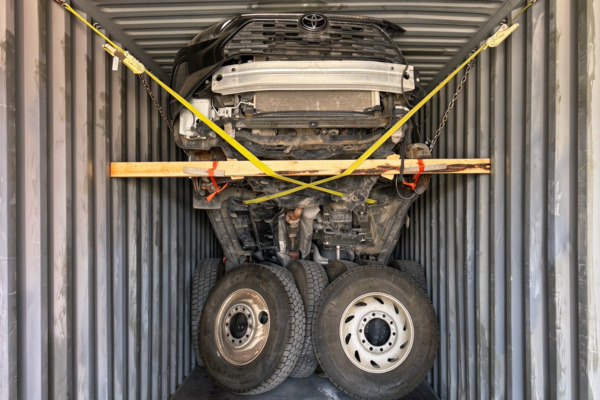
Securing Method Breakdown
Wheel chocking and blocking:
- Hardwood blocks are placed fore and aft of each wheel on the container floor.
- For stacked units, additional blocking is placed at all chassis-rail-to-chassis-rail contact points to prevent lateral shift.
Lashing:
- Four-point cross-lashing is our minimum standard per vehicle: two straps at the front axle area, two at the rear.
- Straps run diagonally to opposite-side D-rings to resist both forward/backward surge and lateral movement.
- For upper units in a stacked configuration, we add straps connecting the upper unit directly to lower chassis rails to prevent the upper unit from shifting independently.
Corrosion protection: Ocean containers are not sealed environments. Humidity, salt air penetration, and temperature cycling during a 20–40 day ocean voyage create real corrosion risk[6] — particularly on bare metal exposed by disassembly.
We apply anti-rust treatment to:
- All exposed axle flanges and hub faces
- Bare metal at removal points (mirror brackets, exhaust mounting flanges)
- Exposed chassis cross-members on the underside of stacked units
This is not cosmetic. On long voyages to West Africa or South America, untreated exposed metal will show surface rust on arrival[7]. Our buyers in those markets have explicitly told us this is a recurring problem with other exporters.
Frequently Asked Questions
Can all types of used trucks be stacked in a container?
No. Stacking is practical for tractor heads (like Scania, Volvo, and MAN units) where a clean chassis rail is available to support an upper unit. Dump trucks, mixer trucks, and large cargo trucks are generally not suitable for stacking due to body geometry, weight distribution, and cab vulnerability.
How many used trucks typically fit in a 40HQ container?
It depends entirely on truck type and configuration. As a general reference: four tractor heads (stacked in pairs) is a common 40HQ load. Two standard dump trucks side-by-side is typical for that category. Mixer trucks usually require one container per unit. These numbers can vary based on specific model dimensions.
Is disassembly damage possible during the loading preparation process?
With experienced personnel, no. Our team has handled this process for 20+ years, and disassembly is done with hand tools under a structured sequence. Removed components are individually wrapped, labeled, and packed alongside the trucks. Buyers receive a packing list documenting every removed part.
How do I verify that a supplier has loaded my trucks correctly before sealing the container?
Request pre-sealing photos from inside the container showing: all trucks in position, lashing straps in place, wooden blocking visible at wheel positions, and removed components packed. A professional exporter will provide these as standard documentation without being asked.
What container type is most commonly used for loading multiple used trucks?
The 40HQ (40-foot High Cube) container is the standard choice[8]. Its internal height of approximately 2.7m provides essential clearance over stacked tractor head configurations and accommodates the height of most commercial truck cabs. Standard 40ft containers (2.35m internal height) are generally not suitable for stacked loading of full-size commercial trucks.
Conclusion
Loading multiple used trucks into one container is a technically demanding process that separates professional exporters from inexperienced ones. The key decisions — disassembly scope, stacking configuration, securing method, and corrosion treatment — must be made correctly for each specific truck type. Tractor heads like Scania and Volvo can be stacked in pairs using cab-over-frame configurations; HOWO dump trucks require side-by-side positioning; mixer trucks present the tightest constraints of all.
At Deli Auto, our operations team has executed this process across thousands of container shipments from our Guangzhou facility. If you are evaluating suppliers for a multi-unit used truck order and want to understand exactly how we would handle your specific truck types, contact us directly — we are happy to share a loading plan before you commit.
[1] "Top Causes of Cargo Damage in Ocean Shipping", https://tnslog.com/top-causes-of-cargo-damage-in-ocean-shipping/. The IMO/ILO/UNECE Code of Practice for Packing of Cargo Transport Units (CTU Code) documents that inadequate securing of cargo within containers is a primary cause of cargo damage during sea transport, including damage from shifting, contact with container walls, and environmental exposure. Evidence role: general_support; source type: institution. Supports: That inadequate cargo securing in shipping containers leads to cargo damage during ocean transit, including contact damage and moisture-related deterioration. Scope note: The CTU Code addresses general cargo securing principles and does not specifically enumerate vehicle-type damage modes such as cracked windshields or cab panel tears ↩
[2] "Federal Size Regulations for Commercial Motor Vehicles", https://ops.fhwa.dot.gov/Freight/publications/size_regs_final_rpt/index.htm. UNECE Regulation No. 46 on devices for indirect vision and ECE vehicle width regulations indicate that exterior mirrors on heavy commercial vehicles can project 200–350 mm beyond the vehicle body on each side, contributing substantially to overall transport width. Evidence role: statistic; source type: government. Supports: The lateral projection distance of exterior rear-view mirrors on heavy commercial vehicles. Scope note: Regulatory mirror projection limits define maximum allowable dimensions rather than actual mirror widths on specific models; the 300–500 mm figure cited in the article may reflect combined mirror assembly depth rather than projection alone ↩
[3] "ISO 668", https://en.wikipedia.org/wiki/ISO_668. ISO 668 and industry specifications published by the World Shipping Council define the nominal internal height of a 40-foot High Cube container as approximately 2.69–2.70 meters, compared to approximately 2.35 meters for a standard 40-foot container. Evidence role: definition; source type: institution. Supports: The standardized internal height of a 40-foot High Cube intermodal container. Scope note: Actual internal dimensions vary slightly by manufacturer and container age; the figures cited represent nominal ISO-compliant specifications ↩
[4] "(PDF) Strength Analysis of Shipping Container Floor with ...", https://www.academia.edu/26307106/Strength_Analysis_of_Shipping_Container_Floor_with_Gooseneck_Tunnel_under_Heavy_Cargo_Load. ISO 1496-1, which specifies requirements for series 1 freight containers, defines floor strength in terms of distributed load capacity; industry guidance notes that concentrated point loads from wheeled vehicles can create stresses that approach floor design limits, particularly when loads are stacked. Evidence role: mechanism; source type: institution. Supports: That ISO intermodal containers have defined floor load capacity limits and that concentrated point loads from stacked cargo can approach or exceed these limits. Scope note: ISO 1496-1 addresses distributed floor loads rather than the specific scenario of stacked vehicle chassis-rail contact points; the per-linear-meter framing used in the article is a practical industry approximation rather than a direct ISO metric ↩
[5] "Compilation of Existing State Truck Size and Weight Limit Laws", https://ops.fhwa.dot.gov/freight/policy/rpt_congress/truck_sw_laws/app_a.htm. Technical specifications published by Sinotruk for the HOWO series heavy dump truck indicate gross vehicle weights ranging from approximately 25,000 to 40,000 kg depending on configuration, with rear tandem axle groups rated to carry the majority of payload load; these weight and geometry characteristics distinguish dump trucks from tractor heads in terms of container stacking feasibility. Evidence role: general_support; source type: other. Supports: That HOWO heavy dump trucks have substantial rear axle loads that create structural constraints for container stacking configurations. Scope note: Manufacturer specifications describe road-use load ratings rather than the specific structural behavior of chassis components under the point-load conditions created by container stacking; the engineering inference about stacking impracticality is the article's own conclusion ↩
[6] "How to Prevent Moisture in Sea Containers", https://unitload.vt.edu/education/white-papers/3-wp-moisture-in-sea-containers.html. Research on container microclimate conditions has documented that temperature differentials between day and night, combined with hygroscopic materials in container flooring, can generate relative humidity levels exceeding 90% inside sealed containers during ocean transit, accelerating corrosion on exposed metal surfaces. Evidence role: mechanism; source type: research. Supports: That shipping containers experience significant humidity fluctuations and condensation during ocean transit, leading to corrosion damage on unprotected metal cargo. Scope note: Published studies on container humidity focus primarily on general cargo and packaged goods; direct measurements of corrosion rates on exposed vehicle chassis components during ocean transit are less commonly documented in peer-reviewed literature ↩
[7] "Marine Atmospheric Corrosion of Carbon Steel: A Review - PMC", https://pmc.ncbi.nlm.nih.gov/articles/PMC5506973/. Corrosion science literature establishes that bare mild steel in marine and tropical environments with relative humidity above 80% and salt deposition can develop visible surface rust (iron oxide) within days to weeks of exposure, with corrosion rates accelerating in the warm, humid conditions characteristic of West African and South American coastal climates. Evidence role: mechanism; source type: research. Supports: That unprotected steel surfaces develop visible surface corrosion when exposed to high-humidity, salt-laden environments over multi-week periods. Scope note: Published corrosion rate data typically addresses open atmospheric exposure rather than the specific microclimate inside a shipping container; actual rust formation timelines depend on steel alloy, surface finish, and container ventilation conditions ↩
[8] "Figure of the week: Africa's used vehicle market and ...", https://www.brookings.edu/articles/figure-of-the-week-africas-used-vehicle-market-and-the-environment/. Industry reports on used vehicle export logistics, including data from UNCTAD and regional port authorities, indicate that 40-foot High Cube containers are the most widely used container type for used vehicle exports from East Asian ports, owing to their superior internal height clearance compared to standard 40-foot units. Evidence role: general_support; source type: institution. Supports: That 40-foot High Cube containers are the predominant container type used in used vehicle export trade. Scope note: Comprehensive global statistics specifically comparing 40HQ versus standard 40-foot container usage for used truck exports are not consistently published; the characterization of 40HQ as the standard reflects widely reported industry practice rather than a single authoritative dataset ↩