Finding old truck parts sounds straightforward — until you receive the wrong part, a mismatched specification, or a component that was never meant for your truck's production year. For overseas dealers managing fleet downtime, that mistake costs more than the part itself. The real challenge is not finding a seller. It is verifying what you are actually buying.
The honest answer: old truck parts are available from multiple channels — direct suppliers, dismantlers, online B2B platforms, and regional dealers. But availability is not the problem. The problem is parts accuracy, supplier reliability, and pre-shipment verification. Buyers who focus only on where to search consistently overlook the harder question — how do I confirm this is the right part, from a trustworthy source, ready to ship?
The sections below walk through how professional buyers approach this sourcing task — starting with the right information, not the right search engine.
Are You Asking the Right Question First?
Most buyers start by asking "where can I find this part?" But in our experience handling parts inquiries from dealers across Africa, Southeast Asia, and South America, the buyers who get burned are usually the ones who found the part quickly — and skipped verification entirely.
The real sourcing question is not "where is this part available?" It is "which supplier can confirm the correct specification, show real pre-shipment evidence, and ship it reliably?" Reframing the task from discovery to due diligence is the single most important shift a professional buyer can make.
The reason this reframe matters is structural. Used truck parts — especially for European brands like Scania, Volvo, MAN, and Mercedes-Benz operating in multi-brand fleets — span years of production changes, regional variants, and configuration differences. A part number alone does not tell the full story.[1]
Why "Part Number" Is Not Enough
Here is a situation we see regularly. A buyer contacts us with a part number for a Weichai engine component. The number exists in multiple engine families produced across different years. Without the engine serial number and production year, we cannot confirm which variant the buyer actually needs. Sending the wrong variant — even one with an identical part number prefix — can result in a fitment failure or, worse, an engine fault that appears weeks after installation.
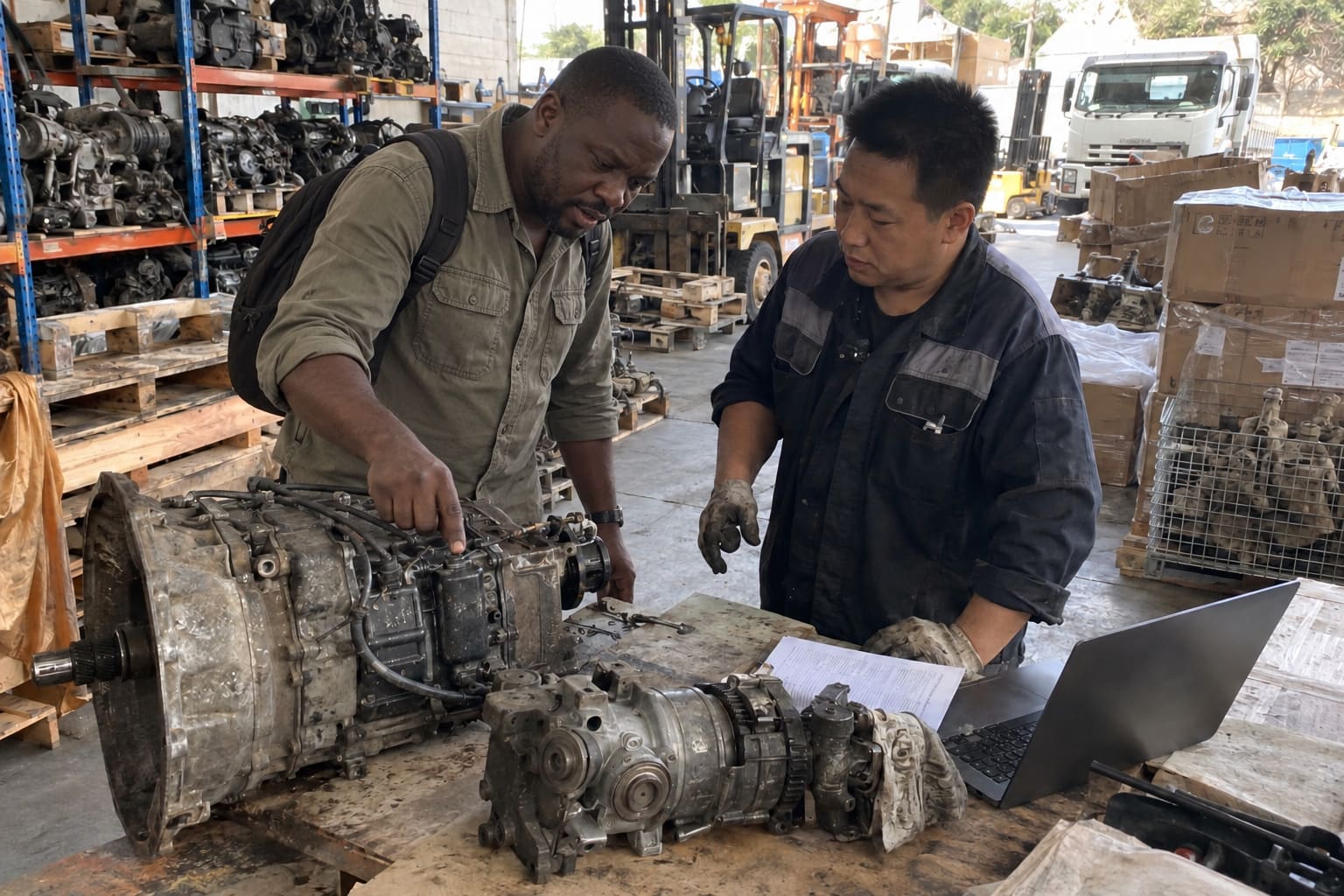
The minimum information a reliable supplier should ask before confirming a match:
- Chassis number (VIN) — identifies the exact vehicle configuration
- Engine model and serial number — distinguishes production variants and displacement configurations
- Gearbox code or axle specification — especially critical for driveline components
- Production year and country of original sale — parts sourced for European markets may differ from those sold into Asia or Africa
- Current fault symptom or replacement reason — helps rule out upstream component failures
If a supplier quotes you immediately based on a keyword or a photo alone, treat that as a warning sign rather than a sign of efficiency.
The Multi-Brand Fleet Problem
Dealers in Africa and Southeast Asia often manage fleets with 10 or more truck brands — HOWO alongside MAN, SHACMAN alongside Volvo, Dongfeng alongside Isuzu. Cross-brand sourcing from a single supplier sounds convenient, but it requires that supplier to carry verified stock across all those brands, not just advertise it.
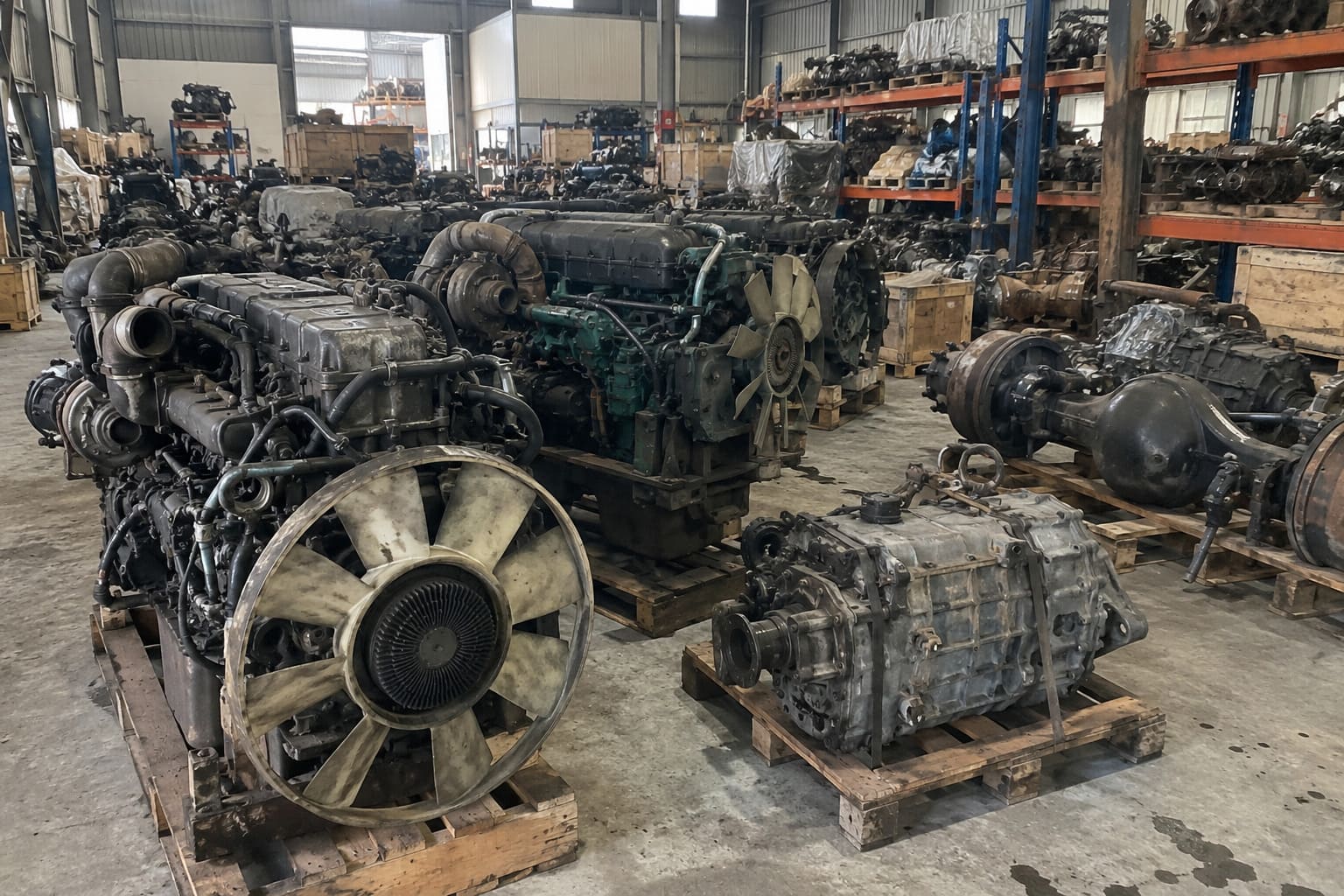
In our warehouse in Guangzhou, we maintain direct stock of engines, gearboxes, and axles for Chinese and European brands because our buyers need multi-brand orders fulfilled in a single container load. When a dealer in West Africa needs three Cummins ISM engines, two ZF 16-speed gearboxes, and one FAST gearbox — all for different trucks in the same fleet — a broker who sources on demand cannot meet that timeline. Ready stock can.
Where Do Professional Buyers Actually Source Old Truck Parts?
There is no shortage of sourcing channels. The question is what each channel reliably delivers — and what risks come with it.
Professional B2B buyers typically source old truck parts from four channels: direct suppliers with physical inventory, B2B platforms like Alibaba or Made-in-China, local dismantlers and salvage yards, and regional distributors. Each channel has a distinct risk profile, and experienced buyers use more than one simultaneously while concentrating volume with one verified supplier.
Sourcing Channel Comparison
| Channel | Stock Depth | Parts Verification | Export Capability | Best For |
|---|---|---|---|---|
| Direct supplier (warehouse) | High | Usually high — depends on supplier | Yes, typically full export service | Bulk orders, container loads |
| B2B platform (Alibaba, etc.) | Variable | Variable — requires buyer due diligence | Often yes, but inconsistent | Price comparison, first contact |
| Local dismantler / salvage yard | Medium | Low — buyer must inspect in person | Rarely | Single units, local sourcing |
| Regional distributor | Medium | Medium | Sometimes | Fast local delivery |
What Each Channel Cannot Do
B2B platforms list thousands of suppliers, but the listings do not tell you whether the part is in physical stock, whether it has been tested, or whether the seller understands multi-brand fitment. Buyers who place a container order based on a platform listing and a low price — without visiting or requesting pre-shipment inspection evidence — take on significant risk.
Local dismantlers can be excellent for single, urgent replacements when a buyer can inspect the part in person. They are rarely the right answer for overseas buyers ordering in volume, because dismantlers typically cannot issue formal export documents, provide consistent quality across a batch, or load a full container.
Regional distributors occupy a middle position. They are faster for local markets but typically carry limited depth on older truck generations. A dealer looking for a Volvo FH12 engine or a MAN TGA gearbox may find that regional distributors simply do not stock those lines anymore.
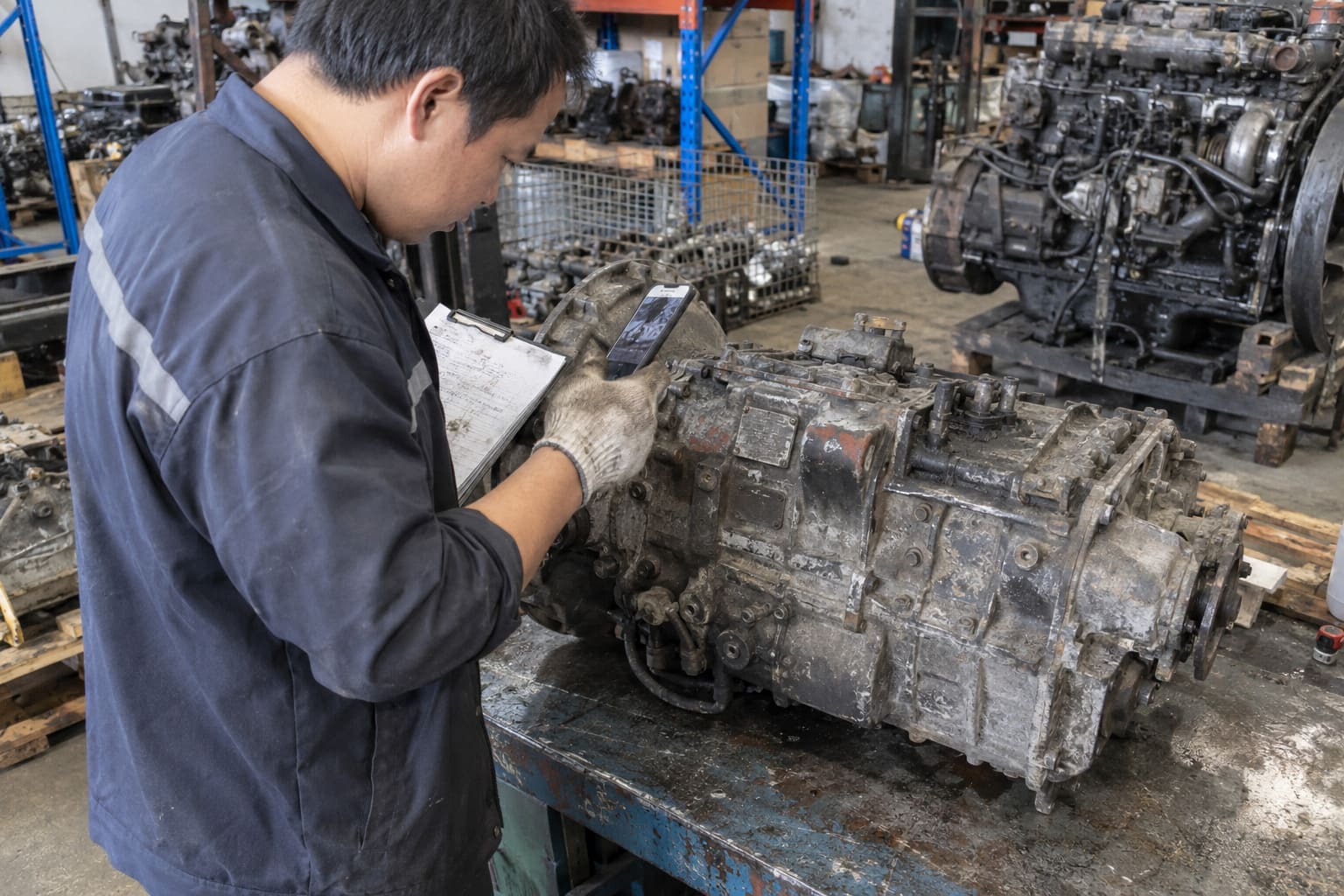
Direct suppliers with physical inventory — like what we operate in Guangzhou — offer the most control over parts accuracy, inspection, and export logistics. But even here, buyers should verify. Ask for real warehouse photos, engine testing video, and proof of prior orders from buyers in your region.
How Do You Verify That an Old Truck Part Is What It Claims to Be?
This is the section most sourcing articles skip. A seller can list anything. The buyer's job is to create friction in that process — not to be difficult, but to filter out sellers who cannot back their claims.
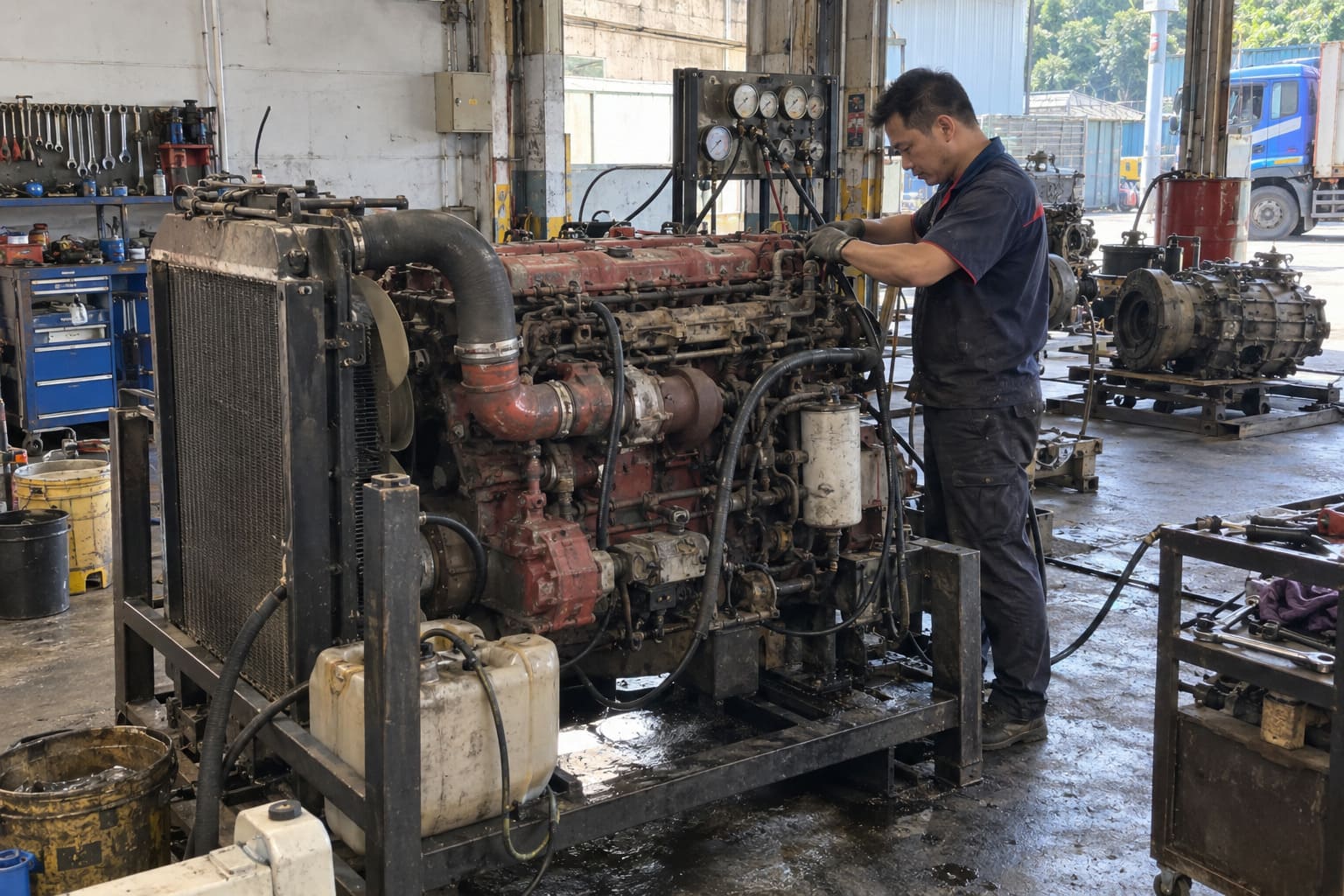
Verifying old truck parts requires four steps: confirming specification match using chassis and engine data, requesting pre-shipment photos and video of the actual part, reviewing engine or gearbox testing records where applicable, and checking the supplier's track record with buyers in your target region. Any supplier unwilling to provide these is a supplier worth avoiding.
The Low-Price Warning Checklist
Significantly underpriced parts are not always a bargain. In our experience, prices that are 30–50% below market often indicate one or more of the following:
- Remanufactured-as-original — the part has been rebuilt but is being described as genuine or OEM
- Wrong specification — the part fits a related model but not the exact one in question
- Previously rejected stock — parts that failed inspection at another buyer's order and were not disclosed
- No actual stock — the seller will source on demand, adding lead time and losing control over what arrives
A short mental checklist before committing to any purchase:
- Has the supplier confirmed the match using chassis and engine data — not just a part number?
- Can they send real photos of the actual part in their warehouse — not catalog images?
- For engines and gearboxes: do they have a testing record or video showing the unit running?[2]
- Have they shipped to buyers in your country or region before? Can they provide references or shipping documentation?
- Do they offer pre-shipment inspection and are they willing to allow a third-party inspector?
What We Ask Before Confirming a Match
At Deli Auto, before we confirm availability for an engine, gearbox, or axle, we typically ask the buyer for the chassis number and engine serial number as a minimum. For gearboxes, we also ask for the number of speeds, the input torque rating, and whether the truck is used on paved roads or off-road — because the same model designation can span different ratio sets[3].
This is not bureaucracy. It is the fastest way to avoid a return shipment.
Does Supplier Inventory Depth Actually Matter?
For buyers ordering one or two parts locally, it may not. For overseas buyers managing fleet downtime across multiple vehicles, it is operationally critical.
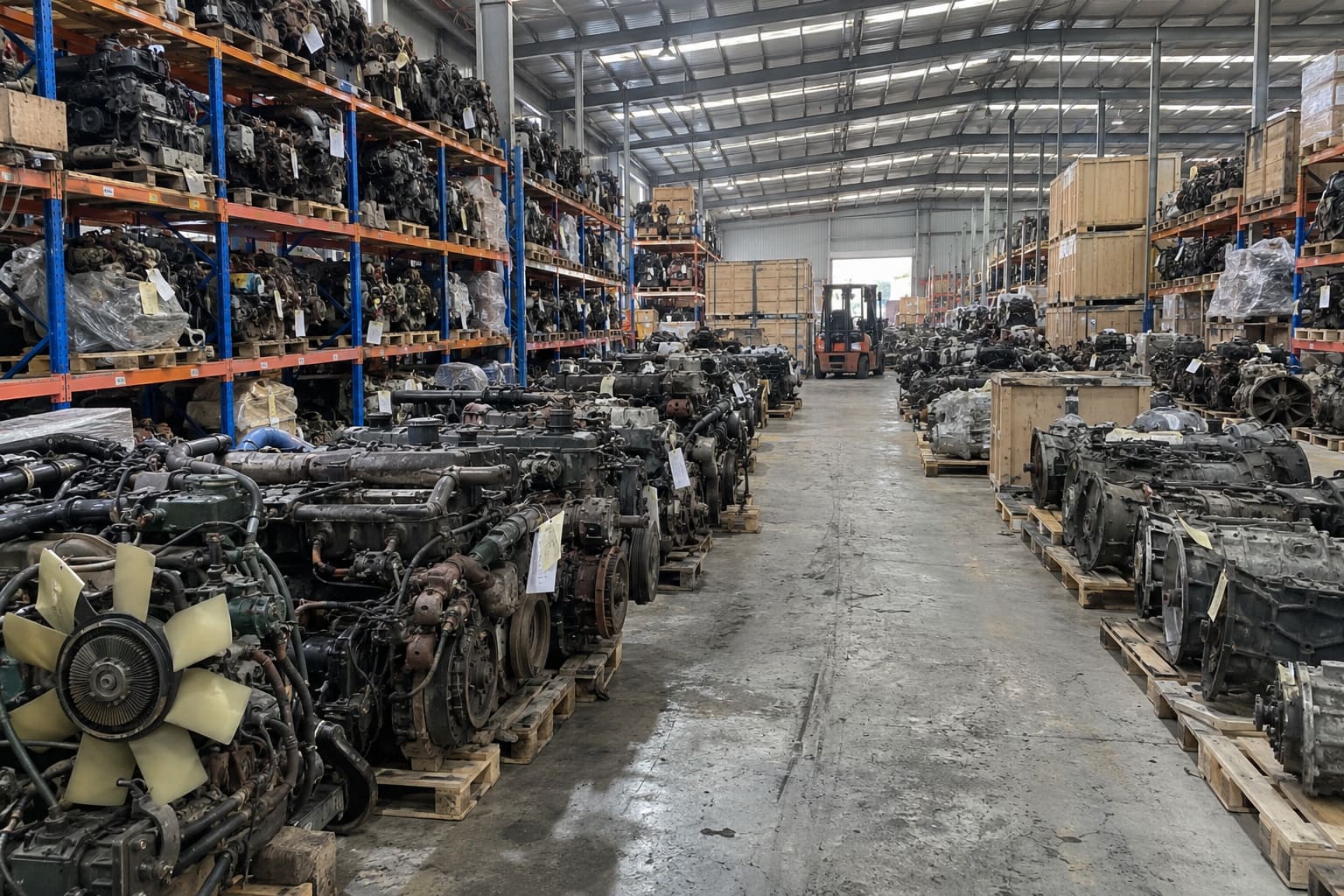
Supplier inventory depth determines how quickly an order ships and how accurately it can be fulfilled. A supplier with large ready stock — engines, gearboxes, axles, and spare parts physically on hand — can typically pack and ship a container within days. A supplier who sources on demand adds weeks of uncertainty and loses quality control over what is actually shipped.[4]
Why Ready Stock Changes the Math
Consider a dealer in East Africa managing a fleet of 30 trucks. Three HOWO dump trucks go down within the same week — two need gearbox replacements, one needs an engine. Every day those trucks are idle costs the fleet owner revenue. The dealer needs parts confirmed, inspected, and loaded within a week.
A sourcing broker who needs to locate those parts, negotiate with multiple dismantlers, and arrange collection cannot meet that timeline. A supplier with 1,000+ gearboxes and 1,000+ engines in a single 12,000㎡ facility — already inspected, already matched by brand and model — can.
Inventory depth also means the supplier has enough volume to have seen the same fitment questions many times. That experience matters. A supplier who handles Scania R-series engine inquiries regularly knows the production year cutoffs where certain configurations changed. A supplier listing "Scania engines" on a platform without holding stock does not.
What to Ask a Supplier About Their Inventory
- How many units of this specific part do you currently have in stock?
- Can you share a photo of the part with your location or a date reference visible?
- What is your lead time from payment confirmation to container loading?
- Do you carry compatible parts for related components in the same truck?
Frequently Asked Questions
What information should I send to a supplier when asking about an old truck part?
Send the chassis number (VIN), engine model and serial number, production year, and the specific fault or replacement reason. For driveline parts, include gearbox code and axle specification. This allows a serious supplier to confirm a match rather than guess — and separates reliable suppliers from those guessing.
How do I know if a used truck part has been tested before shipment?
Ask the supplier directly for a testing record or video. For engines, this means a cold-start or running video showing oil pressure, RPM stability, and absence of smoke. For gearboxes, it means a gear-change test under load. Any supplier offering genuine parts should be able to provide this without hesitation.
Is it safe to buy old truck parts from B2B platforms like Alibaba?
It depends entirely on the supplier, not the platform. Platforms provide access; they do not guarantee stock depth, parts accuracy, or inspection quality. Use platform listings to identify potential suppliers, then apply the same verification checklist[5] you would use with any unknown source — real photos, chassis-number confirmation, shipping references.
Why are some old truck parts much cheaper than market price?
Significantly lower prices often indicate remanufactured parts sold as genuine, wrong-specification stock, or parts sourced from previously rejected batches. Treat large price gaps as a prompt to ask more questions, not as a reason to buy immediately. Request pre-shipment inspection and testing evidence before committing.
Can one supplier cover multiple truck brands in a single container order?
Yes, if the supplier maintains genuine multi-brand inventory in a single facility. This is particularly valuable for dealers managing mixed fleets. Before placing a multi-brand order, confirm that the supplier has each item physically in stock — not just listed — and request a single consolidated pre-shipment inspection report covering all items.
Conclusion
Finding old truck parts is not the hard part. The hard part is confirming that what you receive matches your truck, arrives in the condition described, and comes from a supplier who can repeat that performance on your next order. The buyers who source successfully long-term shift their attention from search channels to supplier verification — asking the right questions before payment, not after.
At Deli Auto, we have spent over 20 years supplying used truck parts and whole vehicles to dealers, fleet operators, and spare parts distributors across Africa, Southeast Asia, South America, and the Middle East. We maintain a 12,000㎡ facility with 1,000+ engines, 1,000+ gearboxes, and thousands of genuine spare parts in ready stock for brands including Scania, Volvo, MAN, Mercedes-Benz, HOWO, SHACMAN, Cummins, Weichai, ZF, and FAST.
If you have a specific part requirement, send us your chassis number, engine model, and part description. We will confirm availability, specification match, and lead time directly — no catalog browsing required.
[1] "What's in a VIN? How to decode the vehicle identification ...", https://news.clemson.edu/whats-in-a-vin-how-to-decode-the-vehicle-identification-number-your-cars-unique-fingerprint/. Automotive parts cataloguing literature notes that OEM part numbers are frequently superseded or shared across model variants, making vehicle identification numbers (VINs) and engine serial numbers necessary for unambiguous component identification; see, e.g., SAE technical documentation on parts interchangeability standards. Evidence role: mechanism; source type: research. Supports: That OEM part numbers are not always unique identifiers across production years and regional variants, and that additional vehicle data such as VIN or engine serial number is required for accurate parts matching.. Scope note: Direct academic literature on this specific limitation is sparse; most authoritative documentation exists within OEM service manuals and industry cataloguing standards rather than peer-reviewed research. ↩
[2] "Engine Testing Regulations", https://www.epa.gov/vehicle-and-fuel-emissions-testing/engine-testing-regulations. The Automotive Parts Remanufacturers Association (APRA) and related industry bodies publish quality standards for remanufactured powertrain components that include operational testing requirements, establishing pre-shipment functional verification as an accepted industry benchmark for used and remanufactured engines and transmissions. Evidence role: expert_consensus; source type: institution. Supports: That operational testing prior to shipment is a recognised quality assurance practice for used or remanufactured powertrain components.. Scope note: Standards published by APRA and similar bodies primarily address remanufactured rather than used-as-removed components; their applicability to all categories of used parts described in the article is contextual rather than direct. ↩
[3] "List of ZF transmissions", https://en.wikipedia.org/wiki/List_of_ZF_transmissions. ZF Friedrichshafen AG's published transmission product documentation for its commercial vehicle gearbox lines, including the Ecosplit and Ecolite series, lists multiple ratio variants under shared model designations, with selection determined by application-specific torque requirements and vehicle configuration; this pattern is consistent across major transmission manufacturers serving the heavy vehicle sector. Evidence role: mechanism; source type: institution. Supports: That commercial vehicle transmission model designations routinely encompass multiple gear ratio variants, requiring additional specification data beyond the model name for accurate component identification.. Scope note: This citation relies on OEM product documentation rather than independent academic sources; the principle is well-established in engineering practice but is not extensively covered in ↩
[4] "(PDF) The Impact of Lead Time Variability on Supply Chain ...", https://www.researchgate.net/publication/385731018_The_Impact_of_Lead_Time_Variability_on_Supply_Chain_Management. Operations management literature on spare parts supply chains, including work published in the International Journal of Production Economics, demonstrates that inventory positioning — maintaining physical stock at or near the point of order fulfilment — is a primary determinant of lead time reliability and inspection consistency in industrial parts distribution. Evidence role: mechanism; source type: research. Supports: That holding physical inventory reduces order fulfilment lead times and enables greater quality control compared to on-demand or broker-mediated sourcing models.. ↩
[5] "Review of Cross-Border E-Commerce and Directions for ...", https://www.sciencedirect.com/org/science/article/pii/S1062737522000014. Academic research on cross-border B2B e-commerce, including studies published in the Journal of International Business Studies and Electronic Commerce Research and Applications, identifies persistent information asymmetry between buyers and sellers on multi-vendor platforms, noting that platform-level trust mechanisms do not substitute for buyer-conducted due diligence in high-value industrial procurement. Evidence role: general_support; source type: research. Supports: That B2B e-commerce platforms facilitate supplier discovery but do not eliminate information asymmetry or quality uncertainty in cross-border industrial parts transactions.. Scope note: Published research on B2B platform limitations tends to address general merchandise or electronics categories; direct studies on automotive or heavy vehicle parts specifically are limited. ↩