Used Hino 700 Buying Guide: What Really Matters Before You Commit?
Buying a used Hino 700 looks straightforward on paper — find a unit, check the year, negotiate the price. But buyers who approach it that way routinely take delivery of trucks that arrive with hidden engine wear, mismatched specs, or parts support problems that no photo or price negotiation could have revealed. The real risk isn't overpaying. It's buying the wrong truck.
The used Hino 700 is one of the most capable heavy-duty trucks in the Asian and emerging-market commercial vehicle space — but condition and configuration determine whether a unit is a productive asset or an expensive liability. Mechanical state varies dramatically between units of the same model year depending on prior use, maintenance history, and how the truck was operated. A structured inspection and a clear spec-to-market match are the two non-negotiable steps before any purchase commitment.
The answer above is the short version. The longer version — the one that separates buyers who receive productive trucks from those who get expensive problems — involves understanding what to inspect, which specs matter for your market, and what parts availability looks like before you commit. Let's work through each of those.
Is the Hino 700's Condition Really That Variable Between Units?
Buyers often assume that same-year trucks from the same brand are roughly equivalent. In practice, the gap between two used Hino 700 units of identical vintage can be enormous — and that gap shows up in repair bills after delivery.
Mechanical condition in a used Hino 700 is almost entirely a function of how the truck was operated and whether it received consistent maintenance — not what year it was made. A 2016 unit with documented long-haul highway history and regular service intervals can be in significantly better mechanical shape than a 2019 unit that spent its working life on construction sites with irregular oil changes.
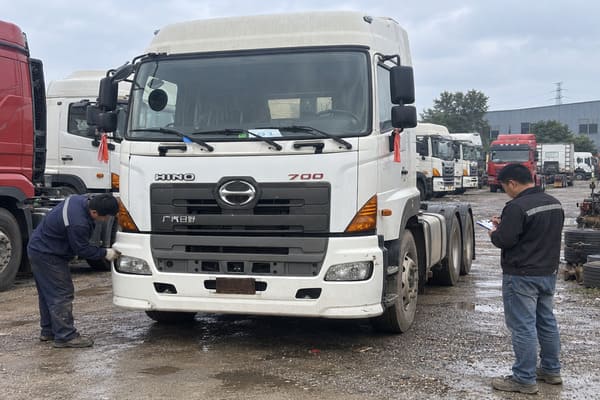
This is one of the most consistent patterns we see when inspecting trucks before export. Two units arrive at our yard in the same week, same year, similar mileage on the odometer — and they are fundamentally different trucks once you get under the hood.
Why Prior Use Creates Such Large Condition Gaps
The Hino 700 platform is built for heavy-duty long-haul freight. Its drivetrain — particularly the E13C engine — performs well under consistent highway load. That's the environment it was engineered for.[1]
When the same truck is used in construction, mining support, or urban distribution, it faces a different stress profile:
- Frequent stop-start cycles accelerate turbocharger and injector wear
- Unpaved road operation pushes contaminants into air filtration and suspension
- Overloading — common in developing-market applications — stresses the frame, axles, and transmission
- Idle time with poor maintenance degrades oil quality faster than highway use
None of this shows up clearly in a model year or a stated mileage figure. Mileage is also easily manipulated on older units.[2] We treat odometer readings as a starting reference, not a condition indicator.
What Legitimate Condition Assessment Looks Like
A credible inspection of a used Hino 700 should include at minimum:
- Engine oil analysis — color, viscosity, and contamination signs
- Exhaust smoke check at cold start and under load — blue smoke indicates oil burning; black smoke points to fueling or turbo issues
- Oil pressure gauge behavior at startup and idle
- Audible checks for knock, tapping, or bearing noise at various RPM ranges
- Coolant condition and thermostat function
- Transmission shift quality through all gears under light load
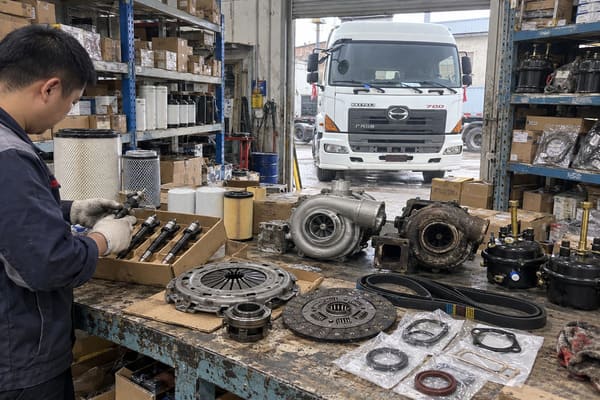
We run engine testing on every unit we sell before shipment. Buyers who've come to us after bad purchases from other sources often describe the same story: the truck looked fine in video, drove acceptably for a brief test, and developed problems within two to three months of delivery. Most of those problems were detectable with a thorough inspection — they just weren't performed.
Which Hino 700 Specifications Should Drive Your Purchase Decision?
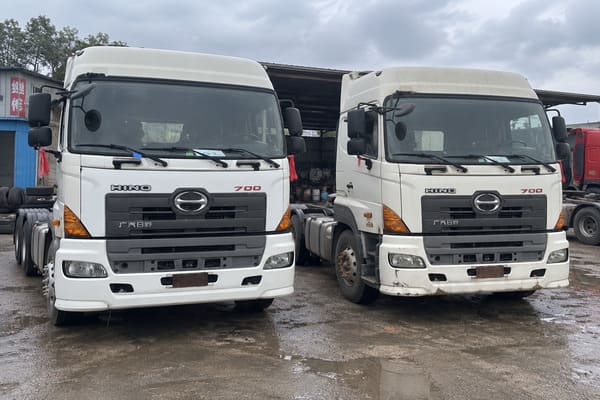
The Hino 700 series is not a single product. It spans multiple cab configurations, wheelbase lengths, axle arrangements, and engine variants.[3] Buying a unit at a good price that doesn't match your end-use market or resale profile is still a poor purchasing decision.
Specification selection in a used Hino 700 purchase should be driven by destination market demand, intended application, and local parts availability — not by what happens to be cheapest or most available at the source. A high-roof sleeper tractor mismatched to a market that runs daycab rigids will sit on your lot. A 6×4 tractor sold into a rigid truck market creates a parts and configuration mismatch.
Understanding the core spec variables — and what they mean for your specific market — is where experienced buyers create an edge over buyers who evaluate on price alone.
Cab Configuration: Sleeper vs. Daycab
The Hino 700 is available in both daycab and high-roof sleeper configurations. The right choice depends on:
| Configuration | Best Suited For | Markets With Higher Demand |
|---|---|---|
| High-Roof Sleeper Cab | Long-haul interstate freight, driver comfort routes | East Africa, parts of South America |
| Daycab / Low Cab | Urban distribution, regional freight, shorter routes | Southeast Asia, Middle East urban markets |
In our experience, buyers in East Africa sourcing tractor units for cross-border freight specifically request high-roof sleepers. Buyers in Southeast Asia more frequently source daycab configurations for regional distribution. Buying a sleeper for a market that doesn't value or need it creates resale difficulty.
Axle Arrangement: 6×4 vs. Other Configurations
The 6×4 is the dominant Hino 700 configuration for tractor and heavy rigid applications. It provides the traction and load distribution needed for both tarmac and mixed-surface routes common in Africa and Southeast Asia.
Consider these practical implications:
- 6×4 tractors suit bulk tanker, container, and heavy haul applications
- Rigid truck configurations (tipper, cargo, crane bodies) have body-specific resale markets
- Drive axle ratio affects fuel economy and highway speed — this should be confirmed, not assumed
Engine Variant and Its Maintenance Implications
The E13C is the primary engine in higher-specification Hino 700 units. It's a robust, long-lived unit when properly maintained. The key question for buyers is not displacement or rated output — it's whether the specific unit you're evaluating has been maintained to a standard that allows the engine to reach its potential service life.
Key things to verify:
- Service record availability — even partial records are better than none
- Injector condition — worn injectors are a common cost item on high-mileage E13C units
- Turbocharger condition — check for shaft play, oil leaks, and response under acceleration
- Timing system — any abnormal noise at startup on a cold engine warrants investigation
What Do You Need to Check Beyond the Engine?
The engine is the highest-stakes component in a used Hino 700 evaluation, but it's not the only one. Buyers focused exclusively on engine condition sometimes take delivery of trucks with transmission problems, damaged frames, or electrical faults that generate their own repair costs.
A complete used Hino 700 inspection must cover the transmission, front and rear axles, frame and suspension, braking system, cab structure, and electrical systems — not just the engine. Transmission and axle issues in particular can generate repair costs that approach or exceed the cost of engine work, and they are often easier to overlook during a superficial inspection.
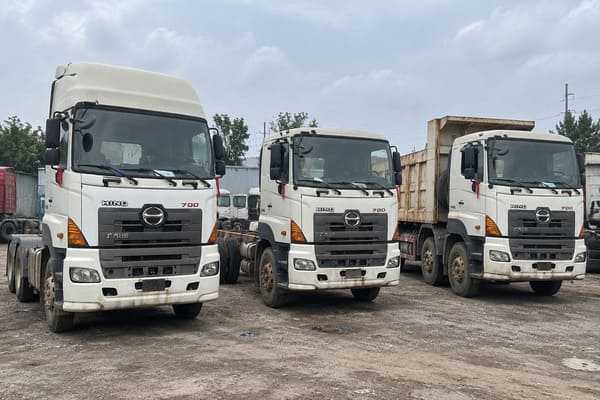
Transmission Inspection Points
The Hino 700 typically runs a synchromesh manual transmission, with automated manual transmission (AMT) variants available in some configurations. Key inspection actions:
- Manual shift test through all gears — any grinding, jumping out of gear, or resistance is a flag
- Clutch engagement point and pedal feel — a clutch riding high on engagement is near end of life
- Check for oil leaks around output shaft seals
- Listen for bearing noise at steady highway speed (simulate on a test drive or rolling inspection)
Axle and Suspension Checks
- Front axle kingpin play — excessive play indicates worn bushings and affects steering and tire wear
- Rear axle differential noise under light load
- Leaf spring condition — check for cracked or missing leaves and U-bolt security
- Wheel bearing play — check all hubs
Frame and Cab Condition
- Frame rail inspection for cracks, welds, and previous repair work — particularly around fifth wheel mounting points on tractors
- Cab tilt function — a cab that won't tilt easily or fully blocks engine access during maintenance
- Door seals, window function, and cab floor condition — indicators of how the truck was cared for
- Rust assessment — surface rust vs. structural corrosion are very different problems
Why Does Spare Parts Availability at Your Destination Matter Before You Buy?
Parts availability is treated as an afterthought by many buyers. It should be treated as a purchase precondition. The Hino 700 is a well-supported platform globally[4] — but "global" is not uniform, and specific markets have specific gaps.
Before committing to a used Hino 700 purchase, buyers should confirm the availability of high-wear and high-failure-risk components in their destination market: injectors, turbochargers, clutch assemblies, brake parts, and engine seals. A truck that becomes immobile due to an unavailable part generates zero revenue and costs yard space — regardless of how good the purchase price was.
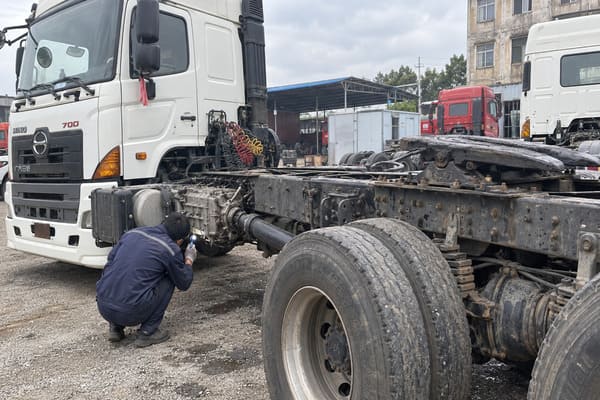
The Cost of Getting Parts Wrong
We regularly hear from buyers who purchased used Hino 700 units without confirming local parts supply. The most common problem scenarios:
- Injector failure with no local Hino 700-compatible injectors in stock — lead times of 4–8 weeks for imported parts
- Turbocharger failure requiring an OEM or high-quality aftermarket unit that the local market doesn't carry
- Transmission parts for specific gear ratios that aren't stocked locally
Each of these scenarios can ground a truck for weeks. For a dealer trying to resell, that's holding cost. For a fleet operator, it's service disruption.
How to Assess Parts Supply Before Committing
Practical steps before purchase:
- Contact local Hino dealers or distributors in your market and ask directly about E13C parts availability
- Ask your supplier if they can include a basic consumables pack with the truck — filters, belts, seals
- Identify at least one reliable aftermarket supplier for common wear items before the truck ships
- Confirm whether your local mechanics have experience with Hino 700 specifically — this affects repair time and diagnosis quality
Some markets — particularly in East Africa and Southeast Asia — have well-developed Hino parts ecosystems.[5] Others are thinner. Knowing which situation you're in before purchase is basic risk management.
Conclusion
The used Hino 700 is a genuinely capable heavy-duty truck with a strong reputation in long-haul and heavy freight applications — but that reputation belongs to well-maintained units, not to the nameplate itself. The most consistent lesson from years of inspecting and exporting these trucks is that mechanical condition and specification match matter far more than model year or asking price.
Before you commit to a purchase, make sure you've addressed three things: a structured mechanical inspection covering engine, drivetrain, and chassis; a clear spec match between the unit's configuration and your market's requirements; and confirmed parts availability at your destination. These steps don't add complexity to the buying process — they protect the investment you're already planning to make.
If you're sourcing a used Hino 700 and want to work with a supplier who inspects before they ship, contact Deli Auto to discuss available inventory and your specific market requirements.
[1] "Hino Profia", https://en.wikipedia.org/wiki/Hino_Profia. Hino Motors' official technical documentation for the E13C engine describes its displacement, rated output, and application class, providing a basis for characterizing the powertrain's design intent for heavy-duty long-haul service. Evidence role: general_support; source type: institution. Supports: The E13C engine's rated output, torque curve, and intended application class as specified by Hino Motors.. Scope note: Manufacturer specifications describe design intent but do not directly address real-world performance variation across different duty cycles. ↩
[2] "Odometer Fraud", https://www.nhtsa.gov/vehicle-safety/odometer-fraud. Government consumer protection agencies, including the U.S. National Highway Traffic Safety Administration, have documented odometer fraud as a persistent problem in used vehicle markets, noting that tampered readings deprive buyers of accurate information about vehicle wear. Evidence role: general_support; source type: government. Supports: That odometer tampering is a documented problem in used vehicle markets, affecting the reliability of mileage as a condition indicator.. Scope note: Most government data on odometer fraud covers passenger vehicles in regulated markets; direct statistics for used commercial vehicle exports from Asia are less systematically documented. ↩
[3] "Hino Profia", https://en.wikipedia.org/wiki/Hino_Profia. Hino Motors' product documentation for the 700 Series describes a range of configurations including daycab and sleeper cab variants, multiple wheelbase options, 6×4 and other axle arrangements, and engine variants, confirming that the series encompasses substantially different vehicles under a common nameplate. Evidence role: definition; source type: institution. Supports: That the Hino 700 series is offered in multiple cab, wheelbase, axle, and powertrain configurations as documented in official product specifications.. Scope note: Available configurations vary by market and model year; not all variants described in global documentation are necessarily available in every export destination. ↩
[4] "Hino Motors", https://en.wikipedia.org/wiki/Hino_Motors. Hino Motors' corporate disclosures indicate that the company sells and services vehicles across numerous countries in Asia, Africa, the Middle East, and other regions, supporting the characterization of the Hino 700 as a platform with broad international distribution. Evidence role: general_support; source type: institution. Supports: That Hino Motors operates in a substantial number of international markets, providing a basis for describing the Hino 700 as a globally distributed platform.. Scope note: Global distribution does not guarantee uniform parts depth or service network quality across all markets; regional variation is significant. ↩
[5] "Why do East African investors prefer Hino lorries over ...", https://www.facebook.com/groups/269407190977842/posts/1109752040276682/. Commercial vehicle market reports for sub-Saharan Africa and Southeast Asia indicate that Japanese truck brands, including Hino, hold substantial market share in these regions, which is generally associated with the development of local dealer and parts distribution infrastructure over time. Evidence role: general_support; source type: institution. Supports: That Hino trucks have significant market presence and established distribution or parts networks in East Africa and Southeast Asia.. Scope note: Market share data reflects new vehicle sales and does not directly measure aftermarket parts depth or availability for specific engine variants such as the E13C. ↩
[6] "A Breakdown of China to USA Shipping Time", https://dimerco.com/blog-post/a-breakdown-of-china-to-usa-shipping-time/. Shipping industry databases and freight forwarder references indicate that container transit times from major Chinese ports such as Shanghai or Tianjin typically range from approximately 20–35 days to East African ports, 7–15 days to Southeast Asian ports, and 25–40 days to West African ports, subject to routing and carrier schedules. Evidence role: statistic; source type: institution. Supports: Approximate ocean freight transit durations from major Chinese ports to East Africa, Southeast Asia, and West Africa.. Scope note: Transit times vary by specific origin and destination port, carrier, routing, and seasonal factors; stated ranges represent typical estimates rather than guaranteed schedules.