Buying a used truck from thousands of kilometers away is one of the highest-stakes procurement decisions a fleet operator or distributor can make. The red flags when buying a used truck are rarely obvious — they hide behind fresh paint, reset odometers, and missing paperwork. Get it wrong, and a broken-down truck in a foreign port is an expensive lesson.
The most dangerous red flags when buying a used truck fall into four categories: manipulated cosmetics masking mechanical failure, incomplete or incompatible documentation, poor post-purchase parts availability, and a mismatch between the truck's history and your actual use case. Recognizing these flags before shipment — not after — is what separates experienced importers from ones who learn the hard way.

Each of these risk categories requires a different kind of scrutiny. A truck that looks road-ready in photos can fail three of these four tests completely. The sections below break down what experienced buyers and inspection teams actually look for — and why the obvious signals are often the wrong ones.
Does the Truck's Appearance Tell You Anything Useful?
A freshly painted truck arriving in your inbox looks like a buying opportunity. In our experience, it is often the opposite.
Cosmetic condition is the easiest thing to manipulate in the used truck trade. Sellers know buyers respond to visual signals. A truck that has been sanded, primed, and repainted in the week before photos were taken may be concealing rust perforation, collision repair, frame straightening, or corrosion damage to the chassis that no amount of paint can fix structurally.
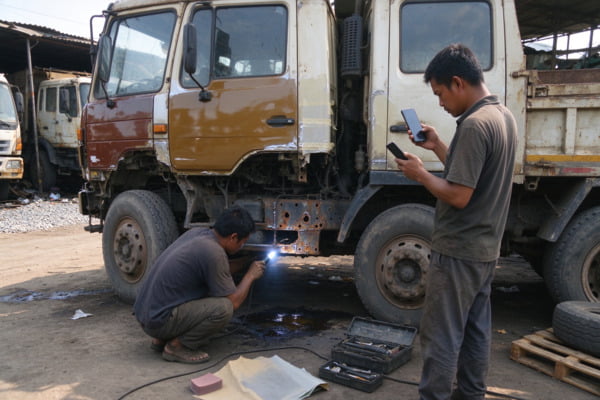
Here is the pattern we see repeatedly: a truck with a dull, unrestored exterior but clean engine bays, consistent service records, and matching wear across drivetrain components is a far safer purchase than a truck that looks showroom-ready but has inconsistent paint depth across panels, mismatched panel gaps, or suspiciously uniform cleanliness under the hood.
What an Inspection Team Actually Looks At
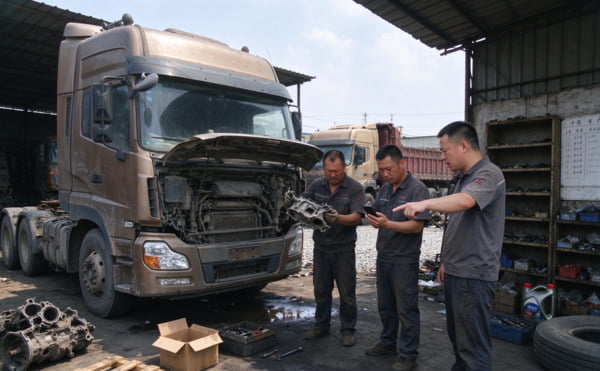
When our inspection team evaluates a used truck, the cosmetic condition is noted — but it is never the primary signal. These are the indicators that actually matter:
- Engine oil color and consistency. Black, sludgy oil points to deferred maintenance. Milky or foamy oil is a serious warning sign for head gasket failure or coolant contamination[1].
- Coolant condition and level. Rust particles or oil residue in the coolant reservoir often indicates internal engine problems that haven't surfaced yet.
- Exhaust smoke under cold start and load. Blue smoke indicates burning oil. White smoke under sustained load (not cold-start condensation) may indicate coolant ingestion. Black smoke points to fueling or injection issues[2].
- Gearbox behavior under load. Shifting hesitation, gear hunting, or unusual resistance under traction load are indicators that photos and odometers will never show.
- Frame and chassis inspection. Straightness, weld repair history, and surface rust penetration — not surface appearance — determine structural integrity.
- Tire wear patterns. Uneven wear across an axle indicates alignment problems, suspension wear, or load distribution issues. New tires fitted immediately before sale are a common concealment tactic.
Why "Low Mileage" Is Often the Wrong Focus
Odometer readings are easy to manipulate[3]. More importantly, even a genuine low-mileage reading tells you very little without knowing how those kilometers were accumulated. A Volvo FH that spent 200,000 km on smooth European highways is mechanically different from one that covered the same distance on unpaved mining roads, even if the odometer reads identically. In our sourcing work, we prioritize documented maintenance history, engine test behavior, and component wear over the number on the dash.
Are the Documents Actually in Order?
Document verification is the blind spot that costs cross-border buyers the most money — not because it's difficult to understand, but because buyers focused on the truck itself often defer it until it's too late.
A truck that cannot clear customs at the destination port, or cannot be legally registered in the buyer's country, is worth nothing — regardless of how well the engine runs.

The core documents that matter for cross-border used truck procurement are the title/ownership certificate, origin documentation, export license (where applicable), deregistration records, and any applicable emissions or roadworthiness certification. Each of these can create a hard stop at the border or registration office if missing or inconsistent.
The Document Issues That Appear Most Frequently
Based on the buyer consultations we handle regularly, these are the document problems that create the most downstream damage:
1. Title Clarity and Lien Status
In some source markets — including parts of Europe and the United States — a vehicle title can carry an existing lien (outstanding finance obligation). A truck sold without clearing that lien is legally encumbered. The buyer may receive the physical vehicle but not clean legal ownership. This is not always a bad-faith transaction; some sellers are unaware. But the buyer bears the consequence.
What to ask: Request a copy of the original title document and confirm that it is free of encumbrances before any deposit is paid.
2. Origin Documentation and Import Duty Classification
Many destination countries in Africa, Southeast Asia, and the Middle East apply different import duty rates based on the country of origin[4]. A truck originally manufactured in Germany but re-exported through a third country may have inconsistent documentation that creates classification disputes at customs. This matters most in markets with preferential trade agreements or specific documentation requirements for used vehicle imports.
3. Destination-Market Registration Compatibility
This is the most underestimated risk. Different countries have specific rules about the maximum age of imported used vehicles, emission standards compliance, right-hand vs. left-hand drive configuration, and axle load limits. A truck that is legal to import in one country may be prohibited in a neighboring market. Buyers purchasing for multi-country distribution need to verify compatibility per market, not just for the first delivery destination.
| Document Type | Why It Matters | Common Problem |
|---|---|---|
| Title / Ownership Certificate | Proves clean legal ownership | Liens, multiple ownership claims |
| Country of Origin Certificate | Affects duty classification | Re-export mismatches |
| Deregistration Certificate | Required by many countries for import | Missing or incorrect date |
| Export License | Required for certain vehicle types | Often overlooked by first-time buyers |
| Inspection / Roadworthiness Cert | Required in some destination markets | Expired or not applicable to import market |
Buyers should treat document review as a pre-deposit step, not a pre-shipment step. By the time the truck is loaded, it is too late to renegotiate on document deficiencies.
Will You Be Able to Find Parts in Your Market?
Parts availability is a selection criterion — not something to figure out after the truck has arrived.
Buyers who prioritize the lowest purchase price and select unfamiliar brands often discover, during the first breakdown, that the nearest compatible part is six weeks away and needs to be air-freighted at significant cost. In some markets, it simply does not exist locally at all.
The total cost of owning a used truck includes not just the purchase price and freight, but the cost of downtime, emergency parts sourcing, and local repair capability. A truck that is $8,000 cheaper to buy but generates $15,000 in downtime costs over two years is not a bargain.
How Parts Availability Varies by Brand and Market
This is not a theoretical risk. In the markets we serve across Africa, Southeast Asia, the Middle East, and Central Asia, parts availability patterns are clear and consistent:
European Brands
Scania, Volvo, MAN, Mercedes-Benz, and DAF have relatively strong dealer and aftermarket networks in East Africa, South Africa, and parts of the Middle East. However, coverage drops significantly in inland Central Africa, some Southeast Asian markets, and smaller Central Asian cities. Even within well-served markets, parts for older model years (pre-2000 for some brands) can be difficult to source.
Japanese Brands
Hino and Isuzu have strong distribution networks across Southeast Asia and parts of East Africa. For buyers in those regions, these brands typically offer lower parts lead times and better local workshop familiarity. However, their representation is thinner in the Middle East and Central Asia.
Chinese Brands
HOWO, SHACMAN, FAW, Dongfeng, and SITRAK parts availability is expanding rapidly in Africa and Southeast Asia as Chinese commercial vehicle presence grows. In markets where Chinese trucks have been established for 5+ years, local parts supply is often good. In newer or smaller markets, it remains inconsistent.
Questions to Ask Before Selecting a Brand
- Is there a local authorized dealer or regional distributor for this brand in your country?
- Are parts available through local aftermarket channels, or only through official dealers?
- Do local mechanics have experience maintaining this brand?
- What is the typical lead time for critical components (engine parts, gearbox, axles) if ordered from outside the country?
A truck that answers "no" to the first three questions is a high-risk purchase regardless of its mechanical condition at the time of sale.
Does the Truck Match Your Actual Use Case?
There is no universal red flag list for used trucks — because the risk profile changes completely based on what you are buying, where you are operating it, and what it will be doing.
A flag that matters enormously for one buyer may be irrelevant for another. The mistake many buyers make is applying a generic checklist without filtering it through their actual operating context.

A tractor unit entering long-haul highway service in Southeast Asia has different failure priorities than a dump truck going into a Central African mining operation. Treating them identically in evaluation leads to mispriced risk.
How Use Case Changes the Risk Hierarchy
Mining and Construction (Dump Trucks, Tipper Trucks)
For heavy-duty site work, the highest-risk areas are:
- Chassis and frame integrity. Repeated overloading and rough terrain stress cause fatigue cracks that can be hidden under underseal or paint[5].
- Hydraulic system condition. Tipping mechanism leaks, cylinder wear, and hydraulic pump condition are specific to dump truck use and easy to overlook on a quick inspection.
- Axle and differential wear. High torque at low speed in rough terrain accelerates differential wear. Ask specifically about differential oil change history and any rebuild activity.
- Cooling system capacity. Mining and construction environments are often hot and dusty. A cooling system that performs adequately in moderate conditions may overheat under site conditions.
Long-Haul Tractor Units (Highway Freight)
For tractor units in logistics and freight:
- Engine hours vs. km (if available). Long-haul engines accumulate hours more proportionally to km; high hour counts relative to km suggest urban or stop-start use, which is harder on engines than highway running.
- Turbocharger condition. Turbo failure is one of the most common issues on high-km engines[6]. Oil contamination, bearing play, and housing damage should be checked directly.
- Clutch wear. On manual transmission trucks, clutch condition is a direct indicator of remaining serviceable life and driver habits.
- Fifth wheel condition. For tractor units, fifth wheel wear and coupling integrity are safety-critical and specific to that truck type.
Buses and Passenger Vehicles
For buyers sourcing used buses:
- Structural integrity of the passenger cell. Corrosion, window seal failure, and floor integrity matter for passenger safety and are often neglected in inspection.
- Brake system condition. Brake fade, uneven wear, and ABS system functionality are non-negotiable.
- Destination market homologation. Many countries have specific certification requirements for passenger-carrying vehicles. Import restrictions are often stricter than for freight trucks[7].
Frequently Asked Questions
Is a freshly painted used truck a warning sign?
In our experience, yes — often. Fresh paint just before sale is a common way to conceal surface rust, collision repair, or chassis damage. It is not automatically a dealbreaker, but it warrants closer physical inspection of the areas paint typically hides: frame rails, wheel arches, cab mounts, and cross-members.
How do I verify a used truck's documents before purchasing from overseas?
Request original or certified copies of the title, origin certificate, and deregistration record before placing a deposit. For cross-border purchases, confirm import eligibility with a local customs broker in your destination country before committing. Document problems discovered after shipment are significantly more expensive to resolve.
Which truck brands have the best spare parts availability in Africa?
It depends on the specific region. Scania, Volvo, and MAN have relatively strong networks in East and Southern Africa. Hino and Isuzu are better supported in parts of West Africa and Southeast Asia. HOWO and SHACMAN parts availability in Africa has improved significantly over the past decade. Buyers should verify local dealer and aftermarket presence for their specific country before deciding on a brand.
What is the most commonly overlooked red flag in used truck procurement?
Based on the buyer conversations we handle most frequently, it is document compatibility with the destination market — specifically, vehicle age restrictions, emissions standards, and drive-side regulations. Buyers focus on the truck's mechanical condition and miss the fact that the truck may be legally inadmissible in their country. This is a hard stop that mechanical quality cannot fix.
Should I always request a pre-shipment inspection?
Yes, without exception, for any multi-vehicle or container-load purchase. Photos are marketing material. A physical inspection by an experienced engineer — checking engine behavior, drivetrain condition, oil systems, frame integrity, and documentation — is the only reliable basis for a purchase decision at distance.
Conclusion
The red flags when buying a used truck are not a single checklist — they are layered signals that shift depending on the truck type, the destination market, and the buyer's operating context. Cosmetic condition tells you very little. Documents matter as much as mechanical condition. Parts availability shapes total cost of ownership more than the purchase price. And the specific failure risks for a mining dump truck are fundamentally different from those for a long-haul tractor unit.
In over 20 years of sourcing and exporting used trucks, the buyers who make the best decisions are the ones who treat procurement as a risk-screening process — not a search for the cheapest truck that looks acceptable in photos.
If you are evaluating a used truck order and want a second opinion on what to check, what documents to request, or whether a specific model suits your market's parts ecosystem, we are happy to walk through the specifics with you. That conversation costs nothing and has prevented a lot of expensive mistakes.
[1] "Milky Oil & Its Dangers", https://www.uti.edu/blog/automotive/milky-oil-its-dangers. Engineering and automotive maintenance literature consistently identifies the presence of emulsified, milky, or foamy engine oil as a symptom of coolant contamination of the lubrication system, most frequently attributable to head gasket failure or cracked cylinder head components. Evidence role: mechanism; source type: education. Supports: That emulsified or milky engine oil is a diagnostic indicator of coolant intrusion, commonly caused by head gasket failure in internal combustion engines. Scope note: The specific presentation may vary by engine design and operating conditions; this indicator should be confirmed alongside other diagnostic checks rather than treated as conclusive in isolation. ↩
[2] "What Causes White Smoke from Diesel Engines?", https://www.uti.edu/blog/diesel/what-causes-white-smoke-from-diesel-engines. Diesel engine diagnostic literature identifies exhaust smoke color as a primary field indicator: blue smoke is associated with combustion of engine oil, white smoke under load with coolant ingestion or incomplete combustion, and black smoke with over-fueling or injector malfunction. Evidence role: mechanism; source type: education. Supports: That exhaust smoke color in diesel engines corresponds to distinct categories of mechanical or fuel system faults. Scope note: Smoke color interpretation can be affected by ambient temperature, load conditions, and engine warm-up state, and should be considered alongside other diagnostic evidence rather than as a standalone determination. ↩
[3] "Odometer Fraud", https://www.nhtsa.gov/vehicle-safety/odometer-fraud. Regulatory agencies and consumer protection bodies in multiple jurisdictions have documented odometer fraud as a persistent problem in used vehicle sales; for example, the U.S. National Highway Traffic Safety Administration has reported that odometer fraud affects hundreds of thousands of vehicles annually, costing buyers significant sums. Evidence role: statistic; source type: government. Supports: The frequency and methods of odometer fraud in used vehicle markets. Scope note: Available statistics typically cover passenger vehicles rather than commercial trucks specifically, so direct extrapolation to the heavy truck segment should be made cautiously. ↩
[4] "African Growth and Opportunity Act (AGOA)", https://www.cbp.gov/trade/priority-issues/trade-agreements/african-growth-and-opportunity-act. National customs tariff schedules and regional trade agreements in markets such as the East African Community, ASEAN, and Gulf Cooperation Council member states establish differentiated duty rates for imported vehicles based on declared country of origin, with preferential rates applying to goods from treaty partners. Evidence role: general_support; source type: government. Supports: That import duty rates on used commercial vehicles differ by country of origin in many developing and emerging markets. Scope note: Duty rates and origin requirements change frequently and must be verified against current official tariff schedules for each specific destination country at the time of importation. ↩
[5] "5.1.6 Frames (393.201) - fmcsa csa", https://csa.fmcsa.dot.gov/safetyplanner/myfiles/SubSections.aspx?ch=22&sec=64&sub=135. Structural engineering literature on vehicle frames documents that repeated stress cycles from overloading and rough terrain operation can initiate and propagate fatigue cracks in chassis members; industry inspection guidance notes that underseal and paint coatings are commonly applied to frame surfaces in ways that can obscure crack formation from visual inspection. Evidence role: mechanism; source type: research. Supports: That cyclic overloading and rough terrain operation induce fatigue cracking in truck chassis frames, and that such cracks can be obscured by underseal coatings or paint. Scope note: Detection of concealed fatigue cracks typically requires magnetic particle inspection or dye penetrant testing beyond standard visual examination, and the article does not specify whether inspection teams employ these methods. ↩
[6] "Common Diesel Engine Problems: Your Troubleshooting ...", https://www.uti.edu/blog/diesel/diesel-engine-troubleshooting-7-common-diesel-engine. Technical literature on diesel engine maintenance identifies turbocharger failure as a common failure mode in high-mileage commercial vehicle engines, typically attributable to oil contamination, bearing wear, or foreign object ingestion, with failure rates increasing substantially beyond recommended service intervals. Evidence role: general_support; source type: research. Supports: That turbocharger failure is a frequently occurring mechanical issue in high-mileage diesel engines used in commercial vehicles. Scope note: Failure frequency data varies by engine manufacturer, maintenance regime, and operating environment; no single universal failure rate applies across all diesel truck platforms. ↩
[7] "Adjusting Imports of Medium- and Heavy-Duty Vehicles ...", https://www.federalregister.gov/documents/2025/10/22/2025-19639/adjusting-imports-of-medium--and-heavy-duty-vehicles-medium--and-heavy-duty-vehicle-parts-and-buses. National transport and vehicle registration authorities in numerous jurisdictions apply specific homologation, roadworthiness certification, and age restriction requirements to imported passenger-carrying vehicles that are distinct from and often more stringent than those applied to freight trucks, reflecting public safety obligations associated with passenger transport. Evidence role: general_support; source type: government. Supports: That imported used passenger-carrying vehicles are subject to additional or stricter regulatory requirements compared to freight vehicles in many destination markets. Scope note: The degree of regulatory differentiation between passenger and freight vehicles varies substantially by country; buyers should consult the specific national transport authority in their destination market for current requirements. ↩